A new robotics and artificial intelligence startup is targeting a major source of hospital waste. The company, Akara, is developing an AI-powered system to streamline surgical suite coordination. This move addresses the significant daily loss of valuable operating room time.
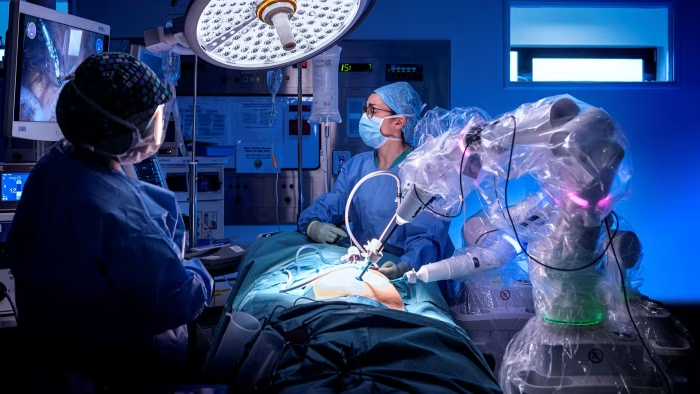 The issue isn’t the surgery itself. Hours are lost daily to manual scheduling and inefficient room turnover. According to TechCrunch, Akara’s system acts like air traffic control for hospital operating rooms.
How AI and Sensors Are Solving a $15 Billion Problem
Operating rooms are among a hospital’s most expensive assets. Yet, studies show two to four hours of OR time are wasted every day. This inefficiency stems from poor coordination between surgeries, cleaning, and patient flow.
Akara’s solution uses thermal sensors and AI software. The system monitors room activity in real-time. It alerts staff the moment a room is ready for turnover. This eliminates guesswork and manual tracking.
The potential savings are enormous. Industry analysts note that reducing OR delays could save the U.S. healthcare system billions annually. For individual hospitals, recapturing even one hour per day translates to major financial and capacity gains.
Broader Impact on Surgical Efficiency and Patient Care
This technology represents a shift from flashy surgical robots to practical infrastructure AI. The focus is on optimizing the entire surgical journey, not just the procedure. This systemic approach can dramatically increase hospital throughput.
For patients, more efficient ORs can mean shorter wait times for elective surgeries. It also reduces the likelihood of last-minute cancellations. For staff, it reduces administrative burden and chaotic coordination efforts.
Akara’s recent recognition on TIME’s Best Inventions of 2025 list validates this pragmatic approach. The innovation signals a growing trend of AI solving foundational, costly operational problems in critical industries like healthcare.
The deployment of AI robotics for hospital operating room coordination marks a critical step toward sustainable healthcare efficiency. This practical application could soon become standard in modern surgical facilities, turning lost time into saved lives.
A quick knowledge drop for you:
What problem does Akara’s technology specifically solve?
It solves operating room coordination delays. The system tracks room status and turnover between surgeries. This recovers hours of lost OR time each day.
How does the AI system work?
It uses thermal sensors to monitor activity in operating rooms. AI software analyzes this data to pinpoint exactly when a room is empty and ready for cleaning and the next patient.
Why is operating room time so valuable?
ORs are extremely expensive to build and maintain. Wasted time directly costs hospitals huge revenue and reduces patient access. Efficient use is critical for financial and operational health.
Has this technology been recognized?
Yes. Akara and its system were recently named to TIME Magazine’s Best Inventions of 2025 list. This highlights its potential impact on the healthcare industry.
Is this a robot that performs surgery?
No. This is a different type of hospital robotics. It is an AI coordination system, not a surgical device. It manages the flow around surgery, not the procedure itself.
জুমবাংলা নিউজ সবার আগে পেতে Follow করুন জুমবাংলা গুগল নিউজ, জুমবাংলা টুইটার , জুমবাংলা ফেসবুক, জুমবাংলা টেলিগ্রাম এবং সাবস্ক্রাইব করুন জুমবাংলা ইউটিউব চ্যানেলে।