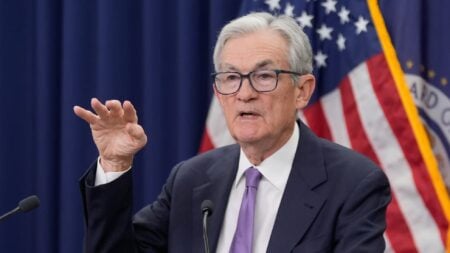
The US Federal Reserve cut interest rates on Wednesday. This marks the third consecutive reduction this year. The decision aims to address growing risks in the labor market.

The move was widely anticipated by financial markets. It brings the key borrowing rate to its lowest level in roughly three years. According to Reuters, the central bank’s action highlights a delicate balancing act.
Internal Divisions and Economic Forecasts Reveal Complex Picture
The rate cut was not unanimous. Three Federal Reserve officials dissented from the decision. Two preferred to hold rates steady, while one argued for a more aggressive cut.
This split underscores deep debates within the central bank. Officials also updated their economic projections. They now foresee slightly stronger growth for 2026.
Inflation expectations were eased slightly for the coming year. The forecasts may still shift due to recent data delays. A record-long government shutdown has impacted the release of key federal statistics.
A Turbulent Path Ahead for Monetary Policy
The central bank faces significant challenges in the months ahead. Its leadership is set for a major change. The term of current Chair Jerome Powell ends in May.
Political pressure on the institution remains high. President Trump has publicly criticized the Fed’s policy. He has also sought to influence its leadership composition.
Analysts warn the economy faces the risk of a “jobless expansion.” This occurs when growth continues but employment gains stall. The labor market is a crucial buffer against a broader recession.
The Federal Reserve’s latest rate cut signals continued concern for economic stability. Policymakers are navigating between persistent inflation and emerging job market risks. Their path forward remains carefully watchful.
Info at your fingertips
Why did the Federal Reserve cut interest rates again?
The central bank cited heightened risks to the labor market. Officials aim to support employment growth even as they monitor inflation levels.
Was the Fed’s decision unanimous?
No, the vote revealed a clear division. Two officials wanted no cut, while one voter supported a larger, half-point reduction.
What is the current interest rate after this cut?
The benchmark rate now sits in a range of 3.50% to 3.75%. This is the lowest it has been in approximately three years.
How does this affect the average consumer?
Lower rates can reduce borrowing costs for items like cars and credit cards. They may also lead to lower returns on savings accounts.
What is a “jobless expansion”?
It is a scenario where the economy grows but job creation remains weak. This makes the economy more vulnerable to slipping into a recession.
জুমবাংলা নিউজ সবার আগে পেতে Follow করুন জুমবাংলা গুগল নিউজ, জুমবাংলা টুইটার , জুমবাংলা ফেসবুক, জুমবাংলা টেলিগ্রাম এবং সাবস্ক্রাইব করুন জুমবাংলা ইউটিউব চ্যানেলে।