Mediators restarted phase two talks on the Gaza ceasefire in Cairo this week, with Egypt, Qatar and Turkey pressing both Israel and Hamas to advance negotiations that have been deadlocked since the first phase concluded in January. The talks bring together representatives of multiple Palestinian factions alongside the three mediating governments, with no direct Israeli-Hamas engagement at the table.
The first phase of the ceasefire, agreed in October 2025 at the instigation of the Trump administration, included a halt to large-scale military operations and an exchange of hostages and prisoners. Israel confirmed in January 2026 that Hamas had returned the remains of the final hostage, completing the first-phase commitments on that front. The ceasefire has held at a basic level since then, though both sides accuse the other of violations.
Phase two is far more complex. It involves negotiations over permanent arrangements for Gaza’s governance, the future of Hamas’s military presence, the return of displaced Palestinians to their homes, and the shape of any reconstruction programme. These are fundamental questions that the first phase deliberately avoided in order to get an initial agreement signed quickly.
Egypt has taken the lead in the Cairo talks and has proposed a framework for phase two that would allow Hamas to participate in a transitional governing body while gradually disarming its military wing over a three-year period. Israel has rejected any arrangement that leaves Hamas with a political role in Gaza. The United States has backed the Israeli position that Hamas must disarm before any political transition can begin.
The timing of the Cairo talks coincides with the broader diplomatic movement around the Iran peace deal and the G7 summit in Évian. Arab leaders attending the Évian summit, including Egypt’s President Abdel Fattah al-Sisi, are expected to press G7 governments on the Gaza issue alongside the Iran framework. Macron has said he wants the Évian summit to produce a clear message on supporting a Gaza political transition.
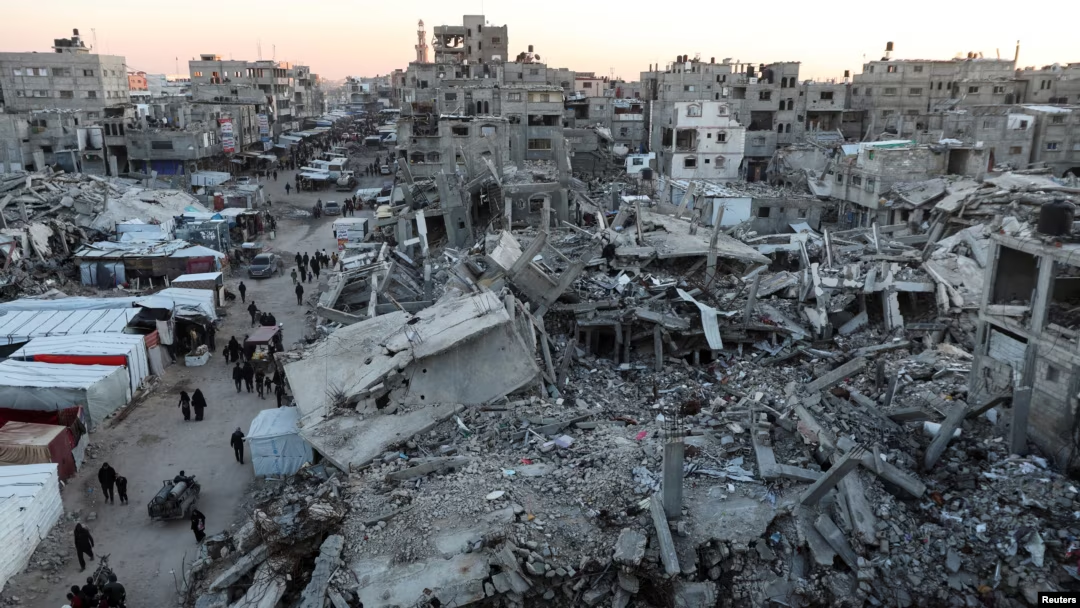
Gaza’s civilian population remains in a severe humanitarian situation. International aid organisations operating in the territory say access has improved since the ceasefire but remains inadequate. Reconstruction has barely begun, as disputes over who governs the territory have prevented any systematic rebuilding effort from getting underway.
The BSS news agency reported that the Cairo talks include representatives from Fatah, Hamas, Islamic Jihad and several smaller Palestinian factions, with the goal of presenting a unified Palestinian position to both Israel and international mediators. Whether that unified position is achievable given the deep divisions between Hamas and Fatah over leadership of a future Palestinian state remains the central obstacle to progress.

Follow iNews Zoombangla On Google
Open the Google follow page and tap the checkmark option to receive more updates from iNews Zoombangla in your Google news feed.