An interstellar comet known as 3I/ATLAS passed through the inner solar system in December 2025, drawing attention after Harvard astrophysicist Avi Loeb discussed toxic gases detected in its coma. The object reached its closest approach to Earth on December 19, 2025, at a distance of about 270 million kilometers.
The discussion has focused on whether any material from 3I/ATLAS could pose a risk to Earth. Scientists say the concern is scientific, not alarmist, and current evidence points to no threat.
Latest Update: Interstellar Comet 3I Atlas and the Chemical Claims
The comparison to World War I chemical weapons comes from the comet’s chemistry. Avi Loeb, the Baird Professor of Science at Harvard University, noted that observations detected cyanide compounds, including hydrogen cyanide, in the gas cloud surrounding 3I/ATLAS. Hydrogen cyanide is historically known as a toxic gas used in early chemical warfare.
Loeb stressed that the reference is historical and chemical, not a claim of danger or intent. Cyanide compounds are commonly detected in comets and are part of normal astrochemical processes. Similar substances have been observed in comets originating within our own solar system.
What made 3I/ATLAS notable is its origin. It is only the third confirmed interstellar object ever observed passing through the solar system, following ‘Oumuamua in 2017 and 2I/Borisov in 2019. Because it formed around another star, scientists see it as a rare sample of material from outside the solar system.
Observations from the James Webb Space Telescope and other facilities allowed researchers to estimate how much gas and dust the comet was shedding as it approached the Sun. Those measurements are central to assessing any possible risk.
According to Loeb’s analysis, the gases released by 3I/ATLAS disperse quickly. The solar wind sweeps charged particles away within a few million kilometers of the comet. Earth’s orbit is tens of millions of kilometers farther away from the comet’s path.
This means toxic gases like hydrogen cyanide cannot survive long enough or travel far enough to reach Earth in meaningful concentrations.
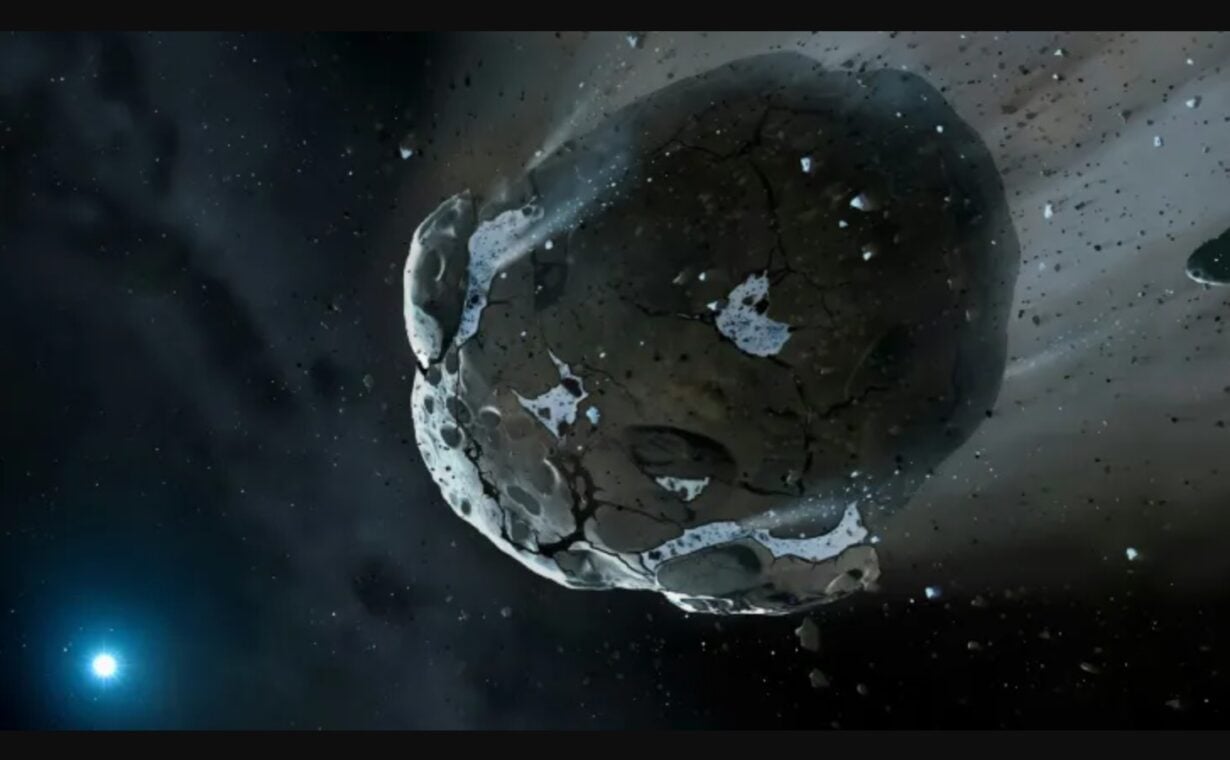
What Scientists Say About Debris, Dust, and Earth Safety
Beyond gas, scientists also examined the possibility of dust or solid fragments reaching Earth. Fine dust particles smaller than a micrometer are pushed away rapidly by solar radiation pressure. These particles disperse even faster than gas.
Larger solid fragments are far less common. Based on mass loss estimates, Loeb calculated that fewer than one million objects larger than one meter could have been released by the comet in recent months. Even those objects remain far from Earth’s path.
The closest projected distance for such fragments is still at least ten times Earth’s radius. Any smaller debris that somehow entered Earth’s atmosphere would burn up before reaching the surface.
Loeb included one theoretical caveat in his discussion. His conclusions assume that the comet’s fragments are natural objects and cannot maneuver using propulsion. This statement was framed as a physical assumption, not as evidence of artificial behavior.
Independent researchers and space agencies have echoed the broader conclusion. The European Space Agency and NASA have not issued any warnings related to 3I/ATLAS. Coverage by outlets such as Reuters, BBC News, and Associated Press has emphasized that there is no credible risk to Earth.
Recent studies have also focused on the comet’s unusual behavior. Astronomers reported wobbling jets and a rare sun-facing anti-tail, observed over several weeks in mid-2025. These features help scientists better understand how icy bodies behave when exposed to intense solar radiation.
The latest update on interstellar comet 3I Atlas confirms that it poses no danger to Earth. Scientists view it as a valuable research opportunity rather than a threat, offering insight into planetary systems beyond our own.
FYI (keeping you in the loop)-
Q1: What is interstellar comet 3I/ATLAS?
3I/ATLAS is a comet that originated outside the solar system. It is only the third confirmed interstellar object ever observed passing through our planetary neighborhood.
Q2: Did 3I/ATLAS come close to Earth?
The comet made its closest approach on December 19, 2025. It remained about 270 million kilometers away, far beyond any danger zone.
Q3: Why did Avi Loeb mention World War I chemical weapons?
Loeb referred to hydrogen cyanide detected in the comet’s gas. The comparison was historical, noting the chemical’s past use, not suggesting a real threat.
Q4: Can gas or debris from 3I/ATLAS reach Earth?
No. Solar wind and radiation disperse gas and dust quickly. Larger fragments remain far from Earth and pose no impact risk.
Q5: Why is 3I/ATLAS important to science?
Because it formed around another star, the comet provides rare insight into the chemistry and physics of other planetary systems.
iNews covers the latest and most impactful stories across
entertainment,
business,
sports,
politics, and
technology,
from AI breakthroughs to major global developments. Stay updated with the trends shaping our world. For news tips, editorial feedback, or professional inquiries, please email us at
[email protected].
Get the latest news and Breaking News first by following us on
Google News,
Twitter,
Facebook,
Telegram
, and subscribe to our
YouTube channel.