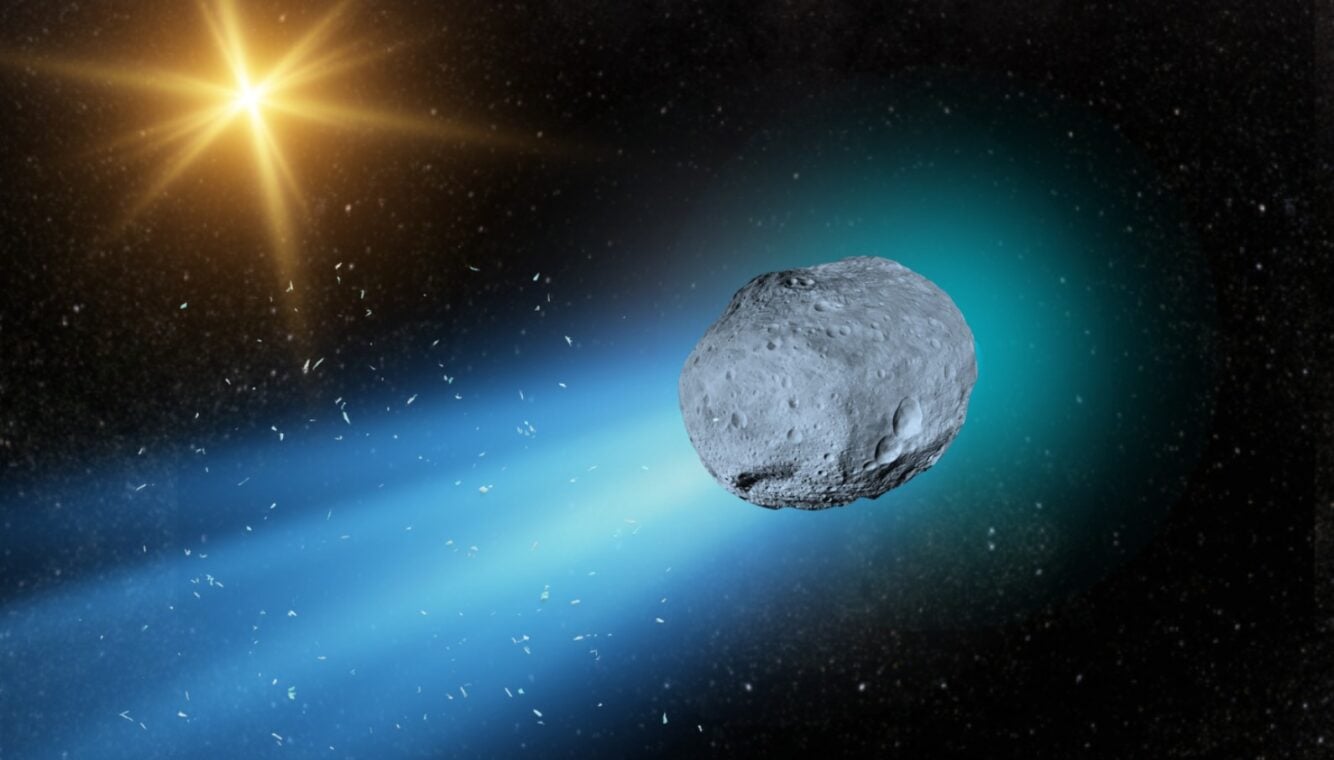
The Hubble Space Telescope has released a new high-resolution image of interstellar comet 3I ATLAS after observing the object on November 30, 2025. The comet is only the third confirmed interstellar visitor ever seen passing through our Solar System. The latest update on interstellar comet 3I ATLAS highlights new structural details in its coma and tail.
The new image shows a bright teardrop-shaped halo extending toward the Sun, offering astronomers fresh insight into the object’s composition and behavior. NASA and the European Space Agency confirmed the image release on December 5, 2025.
Hubble Reveals New Structure Around Interstellar Comet 3I ATLAS
3I ATLAS was first discovered on July 1, 2025, by the NASA-funded ATLAS survey telescope in Rio Hurtado, Chile. At discovery, it was 4.51 astronomical units from the Sun and traveling at about 58 km per second. It arrived from the direction of the constellation Sagittarius, marking it as an object originating outside the Solar System.
The comet passed 0.194 AU from Mars on October 3 and reached its closest point to the Sun on October 30. It will make a close approach to Jupiter on March 16, 2026, at a distance of 0.357 AU.
Astronomers used Hubble’s Wide Field Camera 3 to track the rapidly moving object on November 30. Because the telescope locked onto the comet, background stars appeared as streaks, creating a distinct visual contrast. NASA noted that multiple missions have collected data on the comet since July, and monitoring will continue as it exits the Solar System over the coming months.
Harvard University astrophysicist Avi Loeb said the new image shows a 40,000 km radius glow and an anti-tail stretching roughly 60,000 km. He explained that the shape likely results from macroscopic fragments separating from the comet after perihelion. In earlier research, Loeb predicted that these fragments would appear closer to the Sun by late November, a pattern that matches the new Hubble observations.
Interstellar comets are rare, with only two others confirmed so far: 1I/’Oumuamua (2017) and 2I/Borisov (2019). The latest update on interstellar comet 3I ATLAS continues to draw strong scientific interest because it offers a direct look at material formed in another star system.
How the New Findings Shape Future Research
The latest update on interstellar comet 3I ATLAS gives researchers valuable data on how non-volatile materials behave when exposed to intense solar heating. The extended anti-tail suggests that the comet may contain larger particles than typically seen in Solar System comets.
Scientists also expect that continued tracking through early 2026 will reveal how quickly the comet’s fragments disperse. This could help refine models for the structure and durability of interstellar objects, an active area of study after previous debates surrounding ’Oumuamua’s unusual characteristics.
3I ATLAS will remain visible to major telescopes for several more months, keeping astronomers focused on what this rare visitor can teach us about planetary formation in other star systems.
FYI (keeping you in the loop)-
Q1: What is the latest update on interstellar comet 3I ATLAS?
The newest Hubble image shows a teardrop-shaped coma and a 60,000 km anti-tail. Astronomers say the structure matches predicted fragment separation after perihelion.
Q2: How far is 3I ATLAS from Earth now?
During the November 30 Hubble observation, it was about 286 million km from Earth. Its distance will increase as it travels out of the Solar System.
Q3: Why is 3I ATLAS considered interstellar?
Its hyperbolic orbit and high entry speed indicate it came from outside the Solar System. Its path traces back toward the constellation Sagittarius.
Q4: What did Hubble discover about the comet’s tail?
Hubble revealed an extended anti-tail pointing toward the Sun. Scientists say it likely contains larger particles shed during solar heating.
Q5: Will 3I ATLAS return?
No. Its trajectory is hyperbolic, meaning it will leave the Solar System permanently after completing its passage.
References
NASA. Hubble Takes New Look at Interstellar Comet 3I ATLAS. December 2025.
BBC News. New Hubble Image Reveals Interstellar Comet Structure. December 2025.
Associated Press. Astronomers Study Rare Interstellar Comet 3I ATLAS. December 2025.
iNews covers the latest and most impactful stories across
entertainment,
business,
sports,
politics, and
technology,
from AI breakthroughs to major global developments. Stay updated with the trends shaping our world. For news tips, editorial feedback, or professional inquiries, please email us at
[email protected].
Get the latest news and Breaking News first by following us on
Google News,
Twitter,
Facebook,
Telegram
, and subscribe to our
YouTube channel.