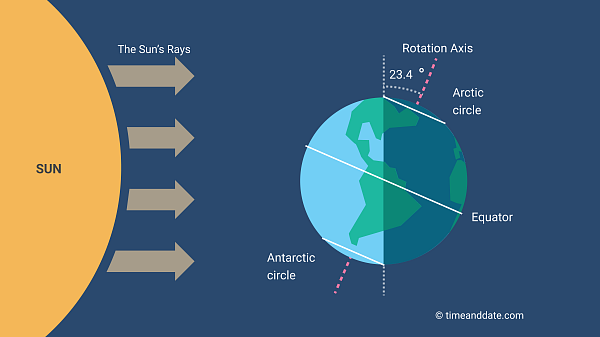
The Northern Hemisphere will experience the shortest day of the year on December 21, 2025. This date marks the astronomical event known as the winter solstice. It is the day with the fewest hours of sunlight and the longest night.This annual event holds deep scientific and cultural significance. It signals the official start of winter in the astronomical calendar. The solstice has been observed by humans for thousands of years.
Understanding the Solstice and Its Global Timing
The solstice occurs due to the Earth’s axial tilt. On December 21, the North Pole is tilted farthest from the Sun. This results in the Sun taking its lowest and shortest path across the sky.Daylight hours will be drastically reduced. In New York, sunrise will be around 7:16 AM with sunset near 4:32 PM. London will see just under 8 hours of daylight. According to timeanddate.com, the precise moment of the solstice is 15:03 UTC.This means the shortest day will fall on a Sunday in 2025. Meanwhile, the Southern Hemisphere will celebrate its summer solstice. Their experience will be the exact opposite, with the longest day.

Ancient Traditions and Modern Observations
Ancient civilizations built monuments aligned with the solstice sun. Stonehenge in England is the most famous example. Its stones frame the sunrise on the winter solstice.Newgrange in Ireland is another prehistoric site. A narrow passage lights up at dawn on the solstice. This proves our ancestors had sophisticated astronomical knowledge.Modern celebrations continue today. People gather at these ancient sites to mark the occasion. Festivals of light, like Yule, are also connected to this time of year.
The Science Behind the Seasonal Shift
It is a common misconception that winter is caused by Earth being farther from the Sun. In fact, Earth is closest to the Sun in early January. The seasons are solely caused by the planet’s 23.5-degree tilt.After December 21, the Northern Hemisphere slowly begins to tilt back toward the Sun. Days will gradually get longer, but the change is almost imperceptible at first. The coldest weather typically lags several weeks behind the solstice.This period is governed by the storage and release of heat from the oceans and land. Meteorological winter, tracked by scientists, began on December 1. The solstice marks the start of astronomical winter.
Miley Cyrus Breaks Silence on Engagement to Maxx Morando After Four-Year Romance
Thought you’d like to know
What is the exact date and time of the 2025 winter solstice?
The 2025 winter solstice occurs on Sunday, December 21. The precise astronomical moment is at 15:03 Coordinated Universal Time (UTC). Local times will vary by time zone.
Why isn’t the coldest day on the shortest day?
Oceans and land masses store heat from the warmer months. They release this stored energy slowly after the solstice. This thermal lag means the deepest cold usually arrives in January or February.
How is the winter solstice different from meteorological winter?
Meteorological winter is a three-month period for weather tracking, from December 1 to February 28. Astronomical winter begins precisely at the solstice. The two systems serve different scientific purposes.
Do all cultures view the solstice as the start of winter?
Not all. Some East Asian calendars mark the start of winter with a different solar term in early November. The solstice is instead considered the “mid-winter” point in those traditions.
How does the solstice affect people’s health?
The lack of sunlight can disrupt circadian rhythms and serotonin levels. This can lead to Seasonal Affective Disorder (SAD) for some individuals. Doctors recommend light therapy and spending time outdoors during daylight.
What happens at the North Pole on the solstice?
The North Pole experiences 24 hours of darkness on the winter solstice. The sun does not rise above the horizon. This polar night lasts for several months.
iNews covers the latest and most impactful stories across
entertainment,
business,
sports,
politics, and
technology,
from AI breakthroughs to major global developments. Stay updated with the trends shaping our world. For news tips, editorial feedback, or professional inquiries, please email us at
[email protected].
Get the latest news and Breaking News first by following us on
Google News,
Twitter,
Facebook,
Telegram
, and subscribe to our
YouTube channel.