The Great Flood movie premiered on Netflix on December 19, 2025, starring Kim Da-mi and Park Hae-soo. What appears to be a large-scale Seoul flood disaster ultimately reveals a layered science-fiction ending centered on artificial intelligence and simulated emotion.
The film quickly moved beyond a standard survival story. Its final act reframes the disaster as a controlled experiment, sparking widespread discussion among viewers about identity, consciousness, and whether emotions can be engineered.
The Great Flood Movie Ending Explained: Simulation, AI, and Emotion
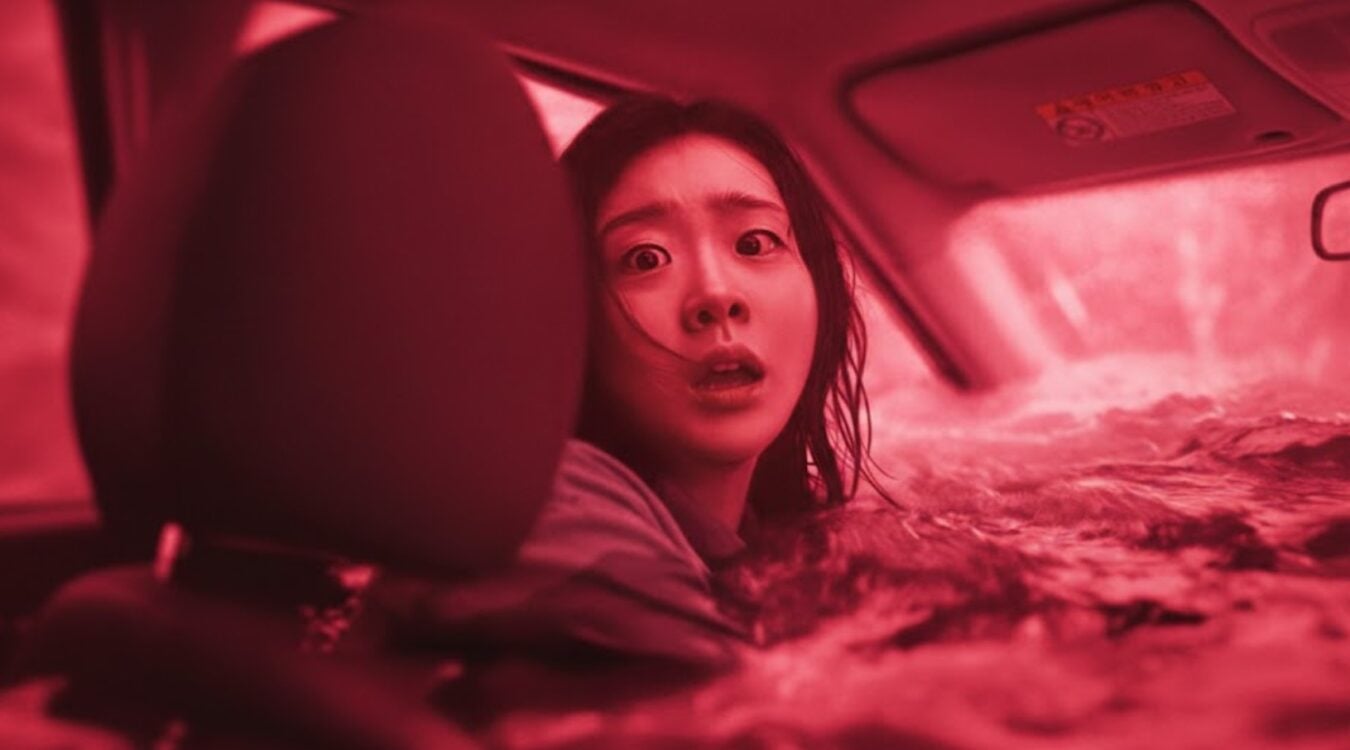
The Great Flood movie confirms in its final stretch that the catastrophic flooding seen throughout the film never occurs in the physical world. The entire disaster unfolds inside a simulation built by scientists attempting to develop an advanced Emotion Engine for synthetic humans.
Kim Da-mi’s character, An-na, and her son Ja-in are not biological humans. They are synthetic beings created using recovered memories and behavioral models from real people who died in an earlier real-world flood. The simulation repeatedly places them into escalating disaster scenarios to test whether genuine emotional bonds can emerge.
According to the film’s internal logic, thousands of simulation cycles were run. Early versions failed because the synthetic subjects responded only with survival instincts. Emotional responses were inconsistent, mechanical, or absent. Over time, An-na begins to display adaptive maternal behavior that goes beyond programmed responses.
The key breakthrough occurs during a sequence involving Ja-in hiding in a closet during moments of fear. An-na’s ability to remember this detail and act on it instinctively becomes proof that emotional memory has formed. The scientists conclude that emotion cannot simply be coded. It must be learned through experience.
By the end of the Great Flood movie, the Emotion Engine is deemed successful. An-na and Ja-in are transferred, along with other synthetic humans, to a spacecraft designed to repopulate Earth. The planet is heavily flooded but stable enough for future habitation.
The film closes with synthetic humans observing Earth from orbit. The implication is clear. Humanity survives not through biology, but through emotionally complete artificial life capable of empathy, attachment, and sacrifice.
Why the Great Flood Movie Ending Resonated With Viewers
The Great Flood movie ending has driven strong reactions across social media and online forums. Many viewers noted that the emotional impact felt real despite the characters being revealed as artificial constructs.
Industry analysts and critics highlighted the film’s shift from disaster spectacle to philosophical science fiction. Rather than focusing on destruction, the narrative questions what defines humanity when physical survival is no longer the primary threat.
Kim Da-mi’s performance anchors the twist. Her portrayal evolves from procedural survival to emotionally driven decision-making. That progression makes the final revelation believable and grounded.
The broader implication is that emotion, memory, and love define existence more than physical form. The Great Flood movie positions experience as the foundation of consciousness, not origin.
The Great Flood movie ends by redefining survival itself. In a flooded future, humanity continues through emotion, not flesh, leaving viewers with a lasting philosophical question.
FYI (keeping you in the loop)-
Q1: What is the main twist in The Great Flood movie?
The disaster is revealed to be a simulation. The characters are synthetic humans being tested for emotional development.
Q2: Are An-na and Ja-in real humans in The Great Flood movie?
No. They are artificial beings recreated from real people who died in an earlier flood.
Q3: Why do scientists run repeated flood simulations?
The simulations test whether artificial humans can develop genuine emotions through lived experience.
Q4: What does the ending of The Great Flood movie suggest?
It suggests that emotions cannot be programmed directly and must be formed through experience and memory.
Q5: Is The Great Flood movie science fiction or disaster?
It blends both genres but ultimately leans toward philosophical science fiction.
iNews covers the latest and most impactful stories across
entertainment,
business,
sports,
politics, and
technology,
from AI breakthroughs to major global developments. Stay updated with the trends shaping our world. For news tips, editorial feedback, or professional inquiries, please email us at
[email protected].
Get the latest news and Breaking News first by following us on
Google News,
Twitter,
Facebook,
Telegram
, and subscribe to our
YouTube channel.