Netflix released a surprising new film on December 19, 2025. “The Great Flood” stars Kim Da-mi and Park Hae-soo. It begins as a gripping survival story in a submerged Seoul.
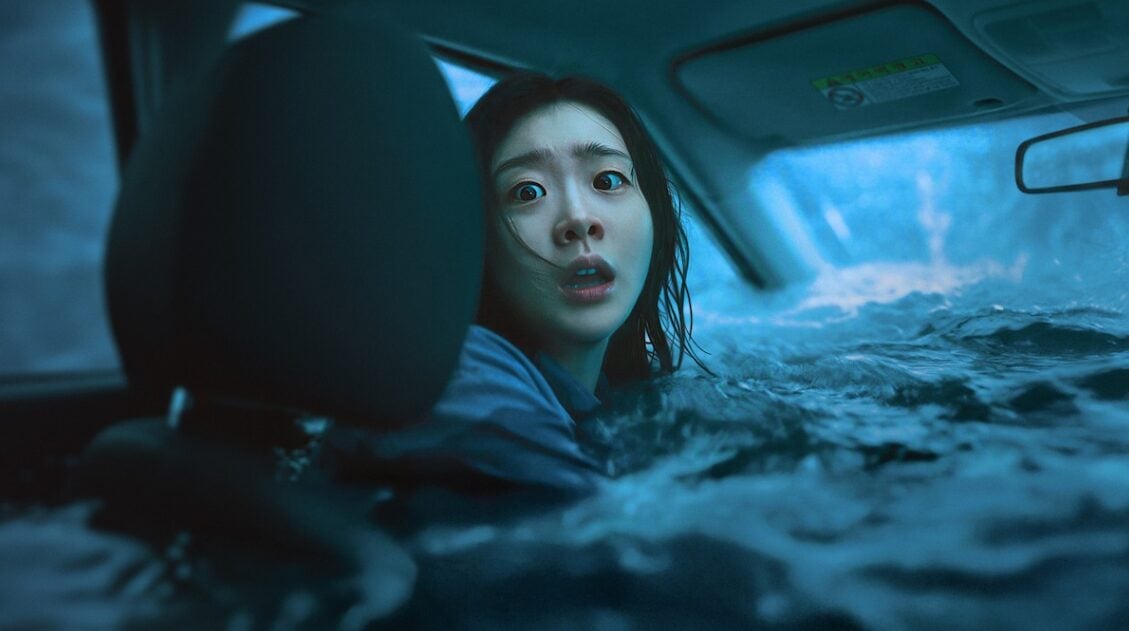
Audiences quickly discovered the movie is far more than a simple disaster flick. According to entertainment analysts, its shocking narrative pivot has sparked widespread discussion online. The film’s true plot involves advanced artificial intelligence and simulated realities.
From Catastrophe to Simulation: Unpacking the Plot
Kim Da-mi plays Gu An-na, an AI researcher fighting to save her son, Ja-in, from a devastating global flood. She teams up with a rescue officer, played by Park Hae-soo. Their desperate climb through a flooding skyscraper forms the movie’s tense first act.
The story takes a radical turn midway. The flood is revealed to be a complex simulation. It is not happening on Earth at all.
This virtual catastrophe is one of thousands run by a space-based research group called the Darwin Center. Their goal is to test an “Emotion Engine.” They use synthetic versions of An-na and her son to see if true maternal love can be developed in AI.
The Emotional Core of the AI Experiment
The simulation has been repeated 21,499 times over nearly six decades. Each cycle allows the synthetic An-na’s consciousness to learn and remember more. Her drive to find Ja-in evolves beyond basic programming.
The breakthrough moment is deeply human. An-na remembers her son always hides in closets when scared. This specific, personal knowledge proves her emotions are genuine. It shows love can be experienced, not just coded.
Variety reports that this philosophical core is what resonates with viewers. The film questions what makes us human if feelings can be replicated. It blurs the line between biological and synthetic life.
Ambiguity and Impact of the Ending
The film concludes with An-na and Ja-in escaping on a spacecraft. They are heading to help rebuild human civilization. Yet, the ending remains intentionally ambiguous.
It is unclear if the characters are the original minds in new bodies or perfected synthetic beings. This open-ended finale encourages debate about consciousness and identity.
The movie’s success lies in this layered storytelling. It uses a high-concept sci-fi premise to explore universal themes of sacrifice and connection. **”The Great Flood” ultimately delivers a powerful message about the nature of love itself**, proving it is an experience that can transcend even our own reality.
Thought you’d like to know
Is The Great Flood based on a true story?
No, it is not based on true events. The film is a work of science fiction. Its core concepts explore theoretical AI and simulation technology.
What is the Emotion Engine in the movie?
The Emotion Engine is a fictional AI system. Its purpose is to generate genuine human emotions in synthetic beings. The flood simulation is its testing ground.
Did An-na and her son survive in the end?
They physically survive the simulation scenario. The synthetic versions of the characters escape Earth. Their ultimate fate and nature are left for interpretation.
Why was the flood simulation created?
Researchers created it to test maternal instinct in AI. They needed a high-stakes, repetitive scenario. The goal was to see if love could emerge from experience.
Where can I watch The Great Flood?
The film is available exclusively on Netflix globally. It premiered on the streaming service on December 19, 2025.
Trusted Sources: Variety, Reuters, Netflix Media Center
iNews covers the latest and most impactful stories across
entertainment,
business,
sports,
politics, and
technology,
from AI breakthroughs to major global developments. Stay updated with the trends shaping our world. For news tips, editorial feedback, or professional inquiries, please email us at
[email protected].
Get the latest news and Breaking News first by following us on
Google News,
Twitter,
Facebook,
Telegram
, and subscribe to our
YouTube channel.