

A new concept for a “Core 5” group of world powers is circulating in Washington. The idea reportedly includes the U.S., China, India, Japan, and Russia. This plan marks a significant shift from traditional Western alliances.
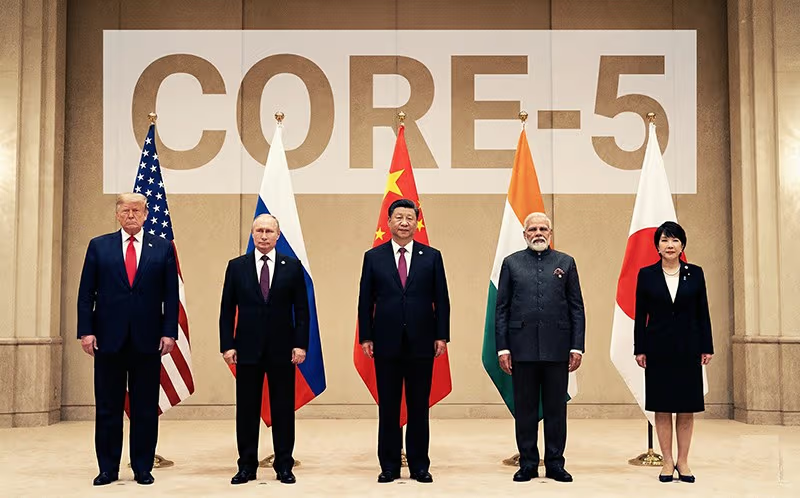
The concept aligns with President Trump’s “America First” foreign policy vision. According to POLITICO, it seeks to engage traditional rivals directly. This contrasts sharply with the existing G7 framework.
Europe’s Exclusion Raises Concerns Among Allies
The proposed group notably excludes European nations. This has sparked immediate concern among U.S. allies across the Atlantic. Analysts see it as a potential acknowledgment of Russian influence in Europe.
Torrey Taussig, a former NSC official, commented on the plan. She said it reflects a non-ideological view favoring strongmen. The approach suggests a focus on regional spheres of influence.
European nations reliant on U.S. support are watching closely. They fear softer U.S. language could weaken efforts to confront Moscow. The war in Ukraine makes this shift particularly sensitive.
A Strategic Pivot to “Flexible Realism”
The discussion follows an updated U.S. national security strategy. That document emphasizes “flexible realism” as a guiding principle. Policy is now defined by “what works for America” above all else.
This represents a departure from Trump’s first-term stance on China. Earlier policy framed the relationship as a “great power competition.” The new approach seeks direct engagement with rivals like Beijing and Moscow.
Defense Secretary Pete Hegseth previously referenced a “G2” dynamic with China. This language has already drawn criticism from Congress. Some lawmakers view it as a fundamental misreading of the adversarial relationship.
The proposed “Core 5” group underscores a dramatic rethinking of American diplomacy. This Trump foreign policy shift prioritizes direct deal-making with rivals over traditional alliance structures. Its long-term impact on global stability remains a critical open question.
Thought you’d like to know
What is the proposed “Core 5” group?
It is a concept for a new group of powerful nations. The group would include the U.S., China, Russia, India, and Japan. The idea is to engage major rivals directly outside traditional forums like the G7.
How have European allies reacted?
European allies have voiced significant concern. The exclusion of Europe suggests the U.S. may view Russia as the dominant power there. This worries nations dependent on U.S. support against Russian aggression.
Where did this concept originate?
The idea was reported by POLITICO. It reportedly appeared in a longer draft of the National Security Strategy. The White House has denied an alternative version of the strategy document exists.
How does this differ from past U.S. policy?
It marks a shift from framing China as a “great power” competitor. The new approach seeks direct cooperation. It also moves away from prioritizing traditional European alliances.
What is “flexible realism”?
It is a term used in the recent U.S. national security strategy. It describes a foreign policy motivated solely by what works for America. The principle is closely tied to the “America First” doctrine.
iNews covers the latest and most impactful stories across
entertainment,
business,
sports,
politics, and
technology,
from AI breakthroughs to major global developments. Stay updated with the trends shaping our world. For news tips, editorial feedback, or professional inquiries, please email us at
[email protected].
Get the latest news and Breaking News first by following us on
Google News,
Twitter,
Facebook,
Telegram
, and subscribe to our
YouTube channel.


