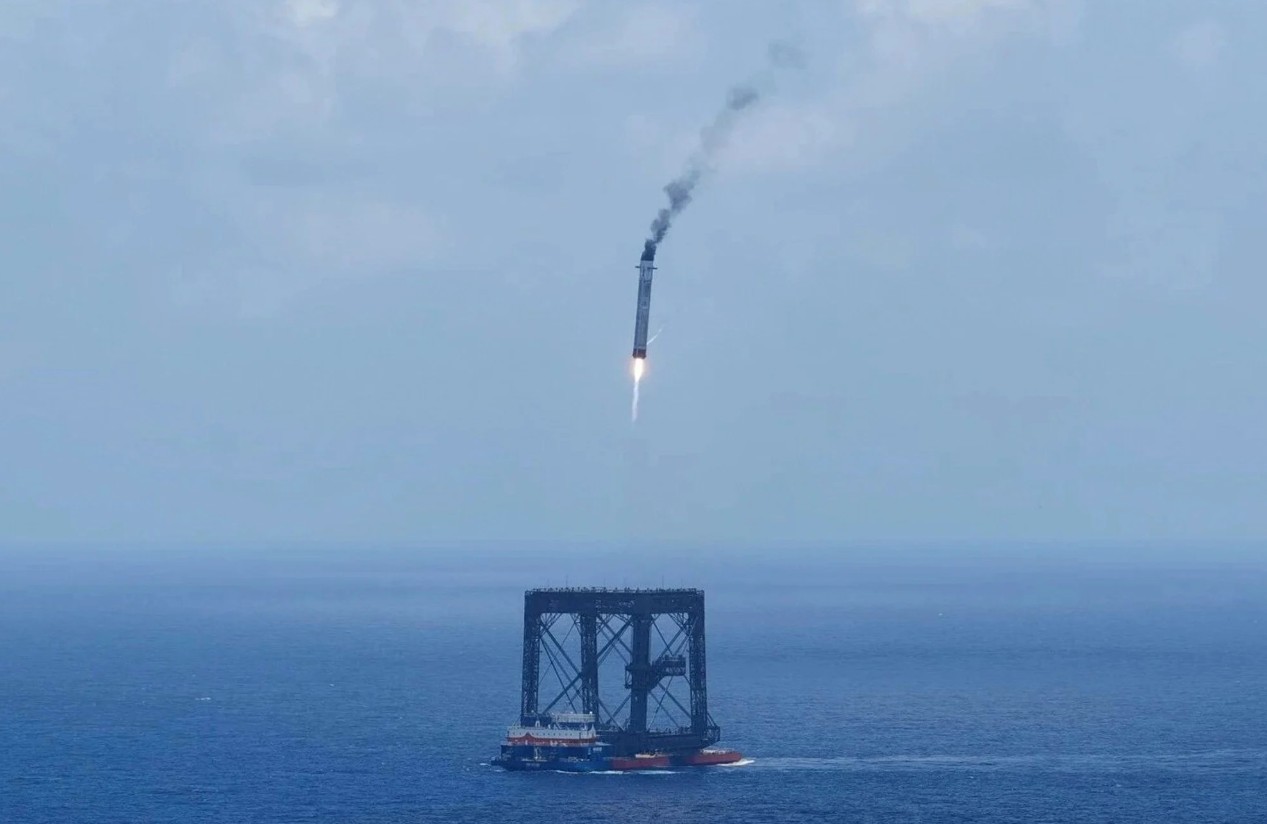
China on Friday successfully tested an experimental rocket retrieval system using a net attached to a sea platform. The Long March 10B lifted off from Hainan at 12:15 p.m. local time. About six minutes after booster separation, the rocket returned vertically and was captured by a specially designed net on an offshore platform.
The test marks China’s first successful retrieval of an orbital-class rocket and the world’s first net-based recovery of a carrier rocket. This puts the country closer to developing fully reusable launch vehicles.
How the Net Capture Works
Unlike SpaceX‘s Falcon 9, which autonomously lands on deployable legs, the Long March 10B uses four “landing hooks” to catch a net attached to a sea platform. This approach simplifies the rocket’s onboard structure, reduces vehicle mass, and increases payload capacity. The net system is highly adaptable to landing-point deviations, effectively expanding the capture window.
Competitive Race With the US
The successful test comes as China accelerates its push into reusable rocket technology. SpaceX has dominated this space for years with its proven Falcon 9 booster recovery program. China’s net-based recovery system represents a different engineering path that could have advantages in flexibility and simplicity once perfected at scale.
Next Steps for Chinese Spaceflight
The test used a production-ready booster, signaling that China intends to move toward operational reuse. Full-scale deployment of a reusable Long March system would significantly reduce launch costs and accelerate the nation’s space exploration capabilities. Multiple test flights will be needed to validate reliability before commercial deployment.
The successful capture opens a new chapter in China’s space program, demonstrating that multiple engineering approaches to reusability can coexist in the global spaceflight industry.
FYI (keeping you in the loop)
How does China’s net recovery compare to SpaceX’s leg landing?
SpaceX’s Falcon 9 boosters land on hydraulic legs and gridfins for directional control. China’s system uses catching hooks and a net, which reduces onboard mass and complexity but requires precise platform positioning. Both methods work, just with different engineering trade-offs.
References
CNN. (2026). China reports reusable rocket breakthrough as it vies to catch up with the US. Published July 10, 2026.
Scientific American. (2026). China’s Long March 10B rocket successfully launches—and lands—in a global spaceflight milestone. Published July 2026.
CGTN. (2026). From space to sea: China’s historic Long March-10B rocket recovery. Published July 11, 2026.

Follow iNews Zoombangla On Google
Open the Google follow page and tap the checkmark option to receive more updates from iNews Zoombangla in your Google news feed.