G7 leaders meeting in Évian-les-Bains used a significant portion of their June summit agenda to address what has become one of the most strategically urgent economic issues facing advanced democracies: their near-total dependence on China for the rare earth elements and critical minerals that underpin modern defence systems, electric vehicles, semiconductors, and clean energy infrastructure.
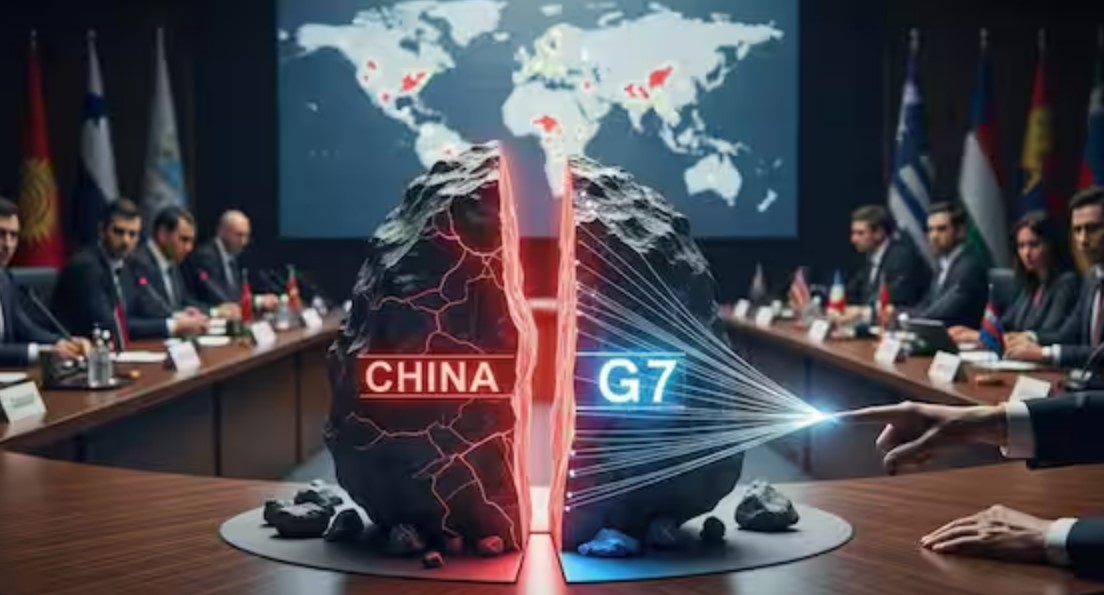
China controls the processing of roughly 85 percent of the world’s rare earth supply, a dominance built over decades through patient state investment in mining, refining, and manufacturing. Beijing has already used export controls on specific critical minerals — including gallium, germanium, and graphite — as economic leverage in trade disputes. G7 governments fear further restrictions as tensions over Taiwan and technology transfer deepen.
France, as host, put forward a draft proposal for a G7 Critical Minerals Partnership that would pool exploration investments, share processing infrastructure across member states, and create jointly funded research centres focused on alternative sourcing from deposits in Africa, Latin America, and Australia. The proposal circulated among delegations ahead of Day 2 of the Evian summit and received cautious support, though finalising details proved contentious.
The United States has been developing its own domestic rare earth programme through executive actions, including fast-tracked mining permits on federal land and subsidies for processing facilities. But building out a domestic alternative to Chinese processing capacity is a multi-decade project at minimum, and even the most optimistic American timelines acknowledge dependence on Chinese supply chains for at least five to ten years for most critical materials.
Japan, which suffered a significant rare earth supply disruption from China in 2010 over a territorial dispute, has been the most vocal G7 member on the need for collective action. Japanese officials brought detailed proposals to Evian on stockpiling agreements and joint exploration investments with partner countries, drawing on lessons from that earlier episode of supply chain vulnerability.
Germany and the UK backed the French partnership proposal in principle but asked for stronger language committing G7 members to tangible investment targets rather than aspirational cooperation frameworks. The tension between countries that want binding commitments and those that prefer flexibility has been a recurring friction point in past G7 efforts on this issue, including at the 2025 summit in Kananaskis, Canada.
Canada, which hosts some of the world’s largest deposits of lithium, nickel, cobalt, and rare earth elements in Quebec and Ontario, offered its own resource base as a foundation for any G7 partnership. Canadian officials signalled willingness to accelerate permitting for G7-allied mining investments and to give partner nations preferential access to processed Canadian output if a reciprocal framework is agreed.
The outcome document on critical minerals is expected to be one of the substantive deliverables from the Evian summit closing on June 17. Whether it contains genuine financial commitments or primarily aspirational language will determine how seriously markets and defence analysts take it as a signal that the G7 is genuinely moving to reduce its strategic vulnerability on critical materials. The summit’s published outcomes will be available through the French presidency’s official G7 Evian portal.