The Nancy Grace Roman Space Telescope launch has placed NASA’s next major infrared observatory on its way to space. NASA said the telescope lifted off from Kennedy Space Center at 7:26 a.m. EDT on Aug. 30 aboard a Falcon Heavy. The mission is designed to examine dark energy, exoplanets and the structure of the universe.
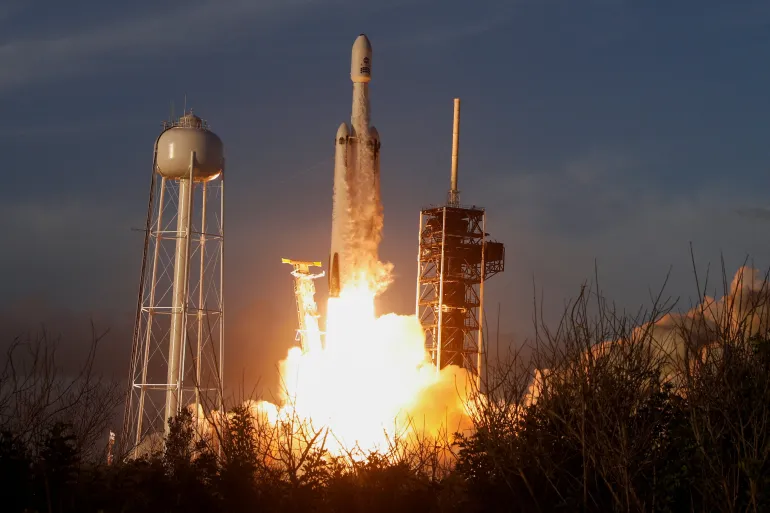
NASA reported that early telemetry arrived after about seven minutes and that the spacecraft separated from the rocket after roughly 31 minutes. Its solar panels and sun shade then deployed. These are early mission milestones, not proof that every instrument is already operating at science performance; commissioning and checks will continue during the journey.
The observatory will travel for about three months toward the second Sun-Earth Lagrange point, roughly a million miles from Earth. From that location, the telescope can conduct wide surveys with fewer interruptions from Earth’s immediate environment. The final observing schedule still depends on commissioning and instrument calibration.
NASA describes Roman as carrying a 300-megapixel infrared camera and as being capable of surveying the sky much faster than Hubble for certain wide-field work. A speed comparison does not mean the two telescopes produce identical images or answer the same questions. Their instruments and observing strategies are different and complementary.
The mission’s first images are expected in early 2027, according to NASA. The observatory is expected to send about 1.4 terabytes of data per day. Machine learning, artificial intelligence and citizen scientists may assist researchers in identifying patterns and objects, but the scientific results will still require calibration, analysis and peer review.
Roman’s science programme is intended to help researchers study how the universe expands and how galaxies and planetary systems evolve. Those are long-term objectives rather than results available on launch day. The mission’s value will be judged after instruments are ready and observations have been compared with other data.
The confirmed news is that NASA successfully launched the Roman telescope and began its transfer to the L2 region. The spacecraft now enters a commissioning phase. Future NASA updates will establish instrument health, initial images and the timetable for public science data.

Follow iNews Zoombangla On Google
Open the Google follow page and tap the checkmark option to receive more updates from iNews Zoombangla in your Google news feed.