Staff Correspondent: At a time when thousands of residents in Tanpara and Jamtala areas adjacent to Nikunja in Khilkhet, Dhaka, are facing severe hardships after being marooned due to continuous heavy rainfall, Dhaka North City Corporation (DNCC) Zone-1 Executive Engineer Nuruzzaman Khan took to the field, even on a public holiday, to address the crisis.

On Friday (July 10) at around 4:00 PM, he conducted an on-site inspection of the waterlogged areas, including Jamtala Jahid Ikbal Chattar, Tanpara, and adjacent parts of Nikunja-1. During the visit, he spoke directly with local residents, listened to their grievances, and discussed ongoing efforts and future courses of action with relevant officials to alleviate the waterlogging.
The Executive Engineer was accompanied by DNCC Zone-1 Assistant Engineer Shyamal Kumar Sarkar, Sub-Assistant Engineer Sajib Hasan, and Work Assistant Abdur Rahman. Also present during the inspection were the Convener of the Nikunja Tanpara Welfare Society and senior journalist Jahid Iqbal, central leaders of the organization Motiur Rahman Swapan and Tasbir Ikbal, along with other committee members and local residents.
During the visit, DNCC officials inspected various submerged roads, alleys, drains, manholes, and drainage outlets. They assessed the situation from a technical standpoint to identify where water was stagnating, what was obstructing the water flow, and where immediate intervention could accelerate drainage. They also gathered crucial firsthand information from the residents.
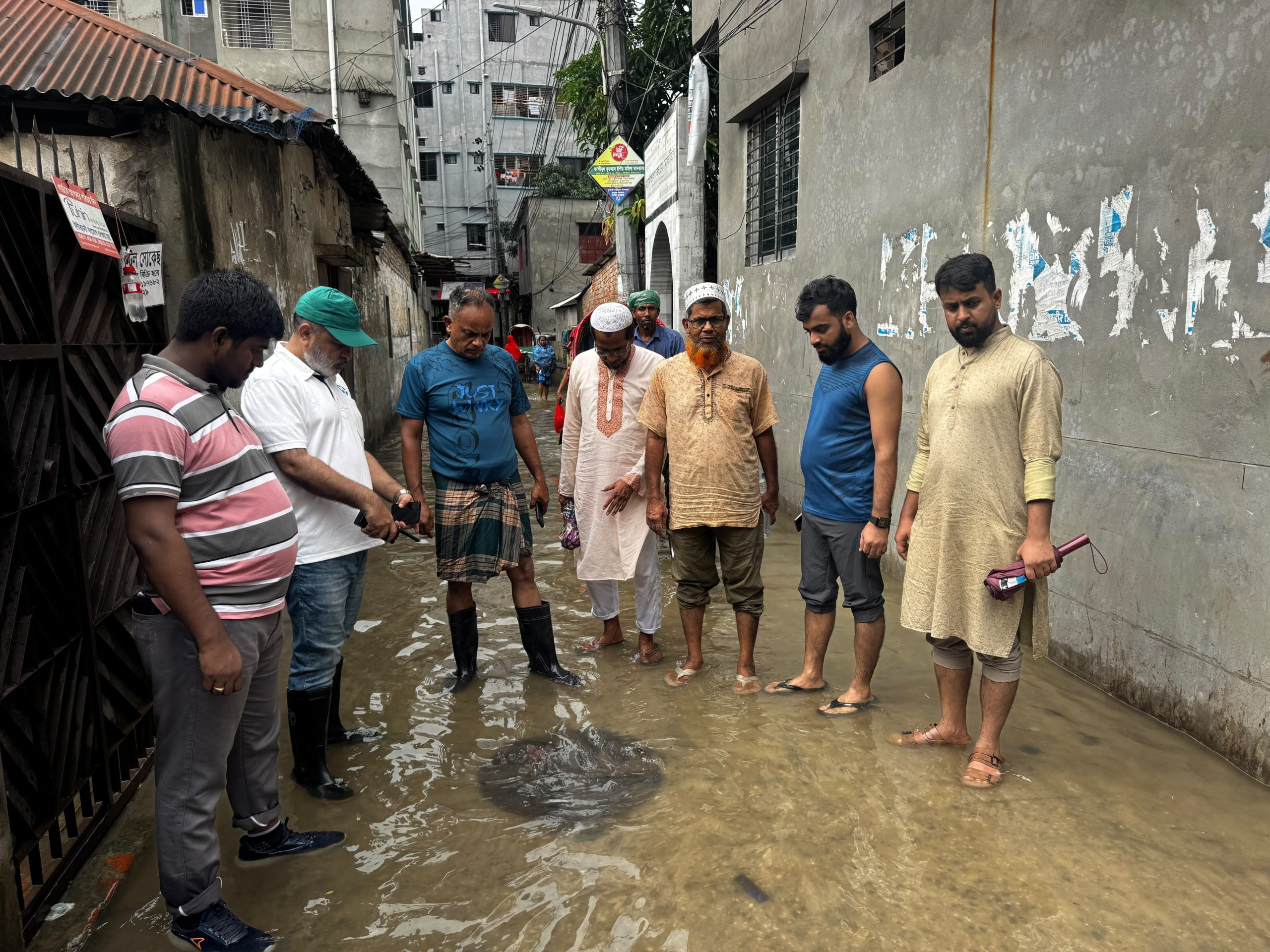
Continuous downpours over the past few days have left many roads in Nikunja-1, Tanpara, Jamtala, and Paschimpara under knee-to-waist-deep water. In several places, rainwater entered the ground floors of houses and buildings, severely disrupting the movement of children, women, the elderly, and patients. Many working professionals failed to reach their workplaces on time, while students faced immense hurdles in attending classes and commuting.
According to local residents, the problem of waterlogging has intensified in recent years due to excessive rainfall. Although several initiatives have been taken at different times to improve the drainage system, low-lying areas quickly submerge during unusual downpours, leading to a recurrence of the same suffering every monsoon.
The Nikunja Tanpara Welfare Society has been actively working on the ground for quite some time to resolve this long-standing issue. The organization has been conducting a series of activities to pinpoint drainage bottlenecks, submit written appeals to authorities, hold multiple meetings with DNCC officials, arrange on-site inspections, clean drains and manholes, and raise awareness among local residents.
Representatives of the welfare society stated that they had initiated the cleaning of crucial manholes in the area before the onset of the current monsoon. However, due to unprecedented levels of rainfall, the initiative could not yield the desired results. Despite this, they have maintained regular communication and coordination with all relevant agencies to find a solution.
The society’s efforts have not been limited to local initiatives alone. To secure a permanent solution to the waterlogging crisis, the organization has consistently engaged with the DNCC, the Bangladesh Army, and other relevant government agencies. They have also presented various long-term proposals highlighting local realities and drainage bottlenecks to the authorities.
Recently, under the supervision of the Bangladesh Army, excavation work has commenced on the canal stretching from the Bonorupa Sluice Gate to the Balu River via the Borua Bridge. Residents strongly believe that once this project is completed, the drainage system of Tanpara, Jamtala, Nikunja, and adjacent areas will become highly effective, significantly reducing the long-standing waterlogging problem. The Nikunja Tanpara Welfare Society had been demanding the implementation of this project for years.
During Friday’s inspection, residents raised their various grievances with the DNCC officials, emphasizing that alongside immediate water removal, an integrated and permanent plan is vital. They stressed the need for regular cleaning of drains and manholes, removal of obstructions to water flow, re-excavation of canals, and the development of modern drainage infrastructure.
A large section of the community noted that while public presence from officials is expected during crises, having DNCC Executive Engineer Nuruzzaman Khan and his team on the ground during a weekend to listen to complaints and discuss solutions was a highly positive and citizen-friendly gesture.
According to urban experts, achieving a permanent solution to Dhaka’s waterlogging requires moving beyond temporary fixes. It demands integrated urban planning, preserving the natural flow of canals and water bodies, regular maintenance of the drainage network, and effective coordination among all service provider agencies.
The local residents hope that the combined efforts of the DNCC’s ongoing initiatives, the Bangladesh Army’s canal excavation project, and the continuous community engagement of the Nikunja Tanpara Welfare Society will result in a sustainable solution to the prolonged waterlogging issue in Tanpara and Jamtala. They expressed optimism that this inspection would not remain a mere formality, but would swiftly lead to effective actions so that residents do not have to suffer the same ordeal in the next monsoon.