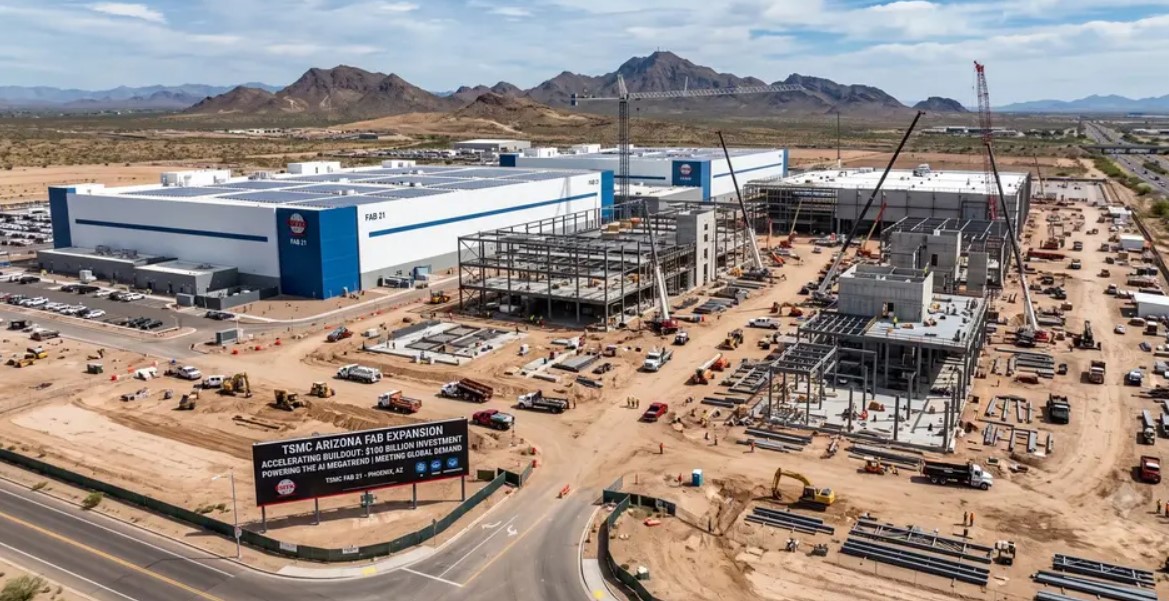
Taiwan Semiconductor Manufacturing Company announced an additional $100 billion investment in Arizona on July 16, bringing total US commitment to $265 billion. The money covers four more 2-nanometer fabs plus advanced packaging facilities. CEO C.C. Wei said the expansion reflects structural demand for AI chips that will last for years.
TSMC raised 2026 capital expenditure to $60–64 billion, up from the previous $52–56 billion range. The company pulled in record profits in Q2 with revenue jumping 77% to $706.6 billion Taiwan dollars, roughly $22 billion. That surge reflects reality: AI is eating semiconductor budgets whole.
What the Arizona Build-Out Means
Arizona now has two TSMC packaging facilities and four advanced fabs already under construction or announced. The new $100 billion will fund four additional plants, potentially bringing the total to ten fabs in the state. It’s a significant geopolitical move. The US gets advanced chip manufacturing on its soil. TSMC gets US government support and customer proximity.
The build-out takes time. Wei indicated the new facilities would come online gradually as market conditions warrant. The company isn’t rushing to overspend. Each plant takes years from groundbreaking to production. TSMC is essentially saying: we believe in this demand cycle, and we’re betting Arizona on it.
Why This Matters
AI models need massive computing power during training. GPUs and specialized processors pull from TSMC’s 2-nanometer and advanced nodes. As AI workloads scale, so does TSMC’s backlog. Apple, AMD, Nvidia, and custom AI companies all depend on TSMC capacity. The chip shortage of 2021–2022 still haunts the industry. No one wants that again.
The Arizona investment signals confidence that AI isn’t a passing trend but a fundamental reshaping of how data centers operate. TSMC wouldn’t commit this much capital on speculation.
Timing and Competition
Samsung and Intel are also investing heavily in US manufacturing. The global competition for chip leadership is turning into a race to build factories fast. Governments are throwing subsidies at the problem. TSMC’s move says: we were already ahead, and we’re staying ahead.
The future of chip manufacturing is increasingly American. TSMC is leading that charge, placing long-term bets on Arizona and AI demand that shows no signs of slowing down.

Follow iNews Zoombangla On Google
Open the Google follow page and tap the checkmark option to receive more updates from iNews Zoombangla in your Google news feed.