

Xiaomi has begun testing humanoid robots inside its electric vehicle factory in Beijing, offering an early glimpse of how human-shaped machines might one day fit into industrial production.
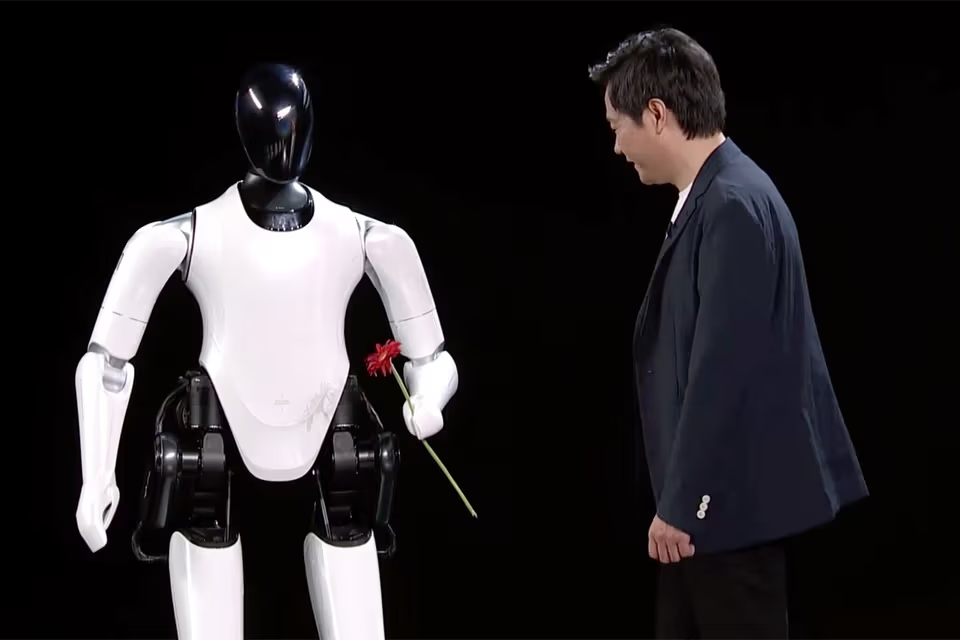
The Chinese consumer electronics company recently conducted a trial run involving two humanoid robots on its assembly line. According to Xiaomi president Lu Weibing, the machines completed 90.2 percent of assigned work during a three-hour test period.
The robots were tasked with a specific job on the line: fastening lug nuts onto a vehicle chassis. In a promotional video released by the company, the two machines can be seen positioned at opposite ends of the line, carefully attaching the small components as the chassis passes between them.
The pace was measured rather than fast. Xiaomi said the robots operated at a cycle time of 76 seconds. In practical terms, that means a new vehicle leaves the factory’s assembly line roughly every minute and 16 seconds, and the robots must keep up with that rhythm.
Lu acknowledged that matching factory speed is the main hurdle when introducing humanoid robots into production environments.
“To integrate robots into our production lines, the biggest challenge is for them to keep up with the pace,” he said in an interview with CNBC.
Despite the relatively slow movements shown in the video, Lu said the robots managed to keep pace with the broader production flow inside the factory.
Even so, Xiaomi is not yet treating the machines as full employees on the line. Lu described them more cautiously.
“The robots in our production lines weren’t doing an official job, more like the interns,” he said.
The trial nonetheless marks a notable moment for Xiaomi’s growing automotive ambitions. The company, long known for smartphones and consumer electronics, has expanded into electric vehicles and continues experimenting with advanced automation inside its manufacturing facilities.
China already leads the world in the deployment of industrial robots, having installed more such machines than any other country to date. Xiaomi’s experiment adds to that broader trend of automation in large-scale manufacturing.
The company is not alone in testing humanoid machines for factory tasks. Earlier this year, a United Kingdom-based firm called Humanoid carried out a pilot project involving robots stacking containers. That test also reported a success rate above 90 percent.
The two trials, however, involved different types of work. The tote-stacking task handled larger items but required less precision, while Xiaomi’s robots were responsible for fastening smaller parts with exact placement.
There is also a technical distinction between the machines. Xiaomi’s robots operate on two legs, moving and balancing like humans. By contrast, the Humanoid robots used in the earlier trial were mounted on a fixed base rather than walking independently.
For now, the experiments remain limited to pilot runs. No company has yet confirmed the full-time deployment of bipedal robots across an industrial production line.
Still, the early tests suggest manufacturers are steadily exploring how humanoid machines might eventually operate alongside human workers in factory environments.
Read More:
Xbox Full Screen Experience Set to Reach Lenovo Legion Go as Early Testing Begins
As Xiaomi’s trial shows, the technology may still be learning its role on the assembly line. For the moment, the company itself describes the robots as newcomers—present, capable, but still in training.
iNews covers the latest and most impactful stories across
entertainment,
business,
sports,
politics, and
technology,
from AI breakthroughs to major global developments. Stay updated with the trends shaping our world. For news tips, editorial feedback, or professional inquiries, please email us at
info@zoombangla.com.
Get the latest news and Breaking News first by following us on
Google News,
Twitter,
Facebook,
Telegram
, and subscribe to our
YouTube channel.


