The transition from champions to contenders often begins quietly. For the Brazil women’s national team, the shift feels more deliberate.
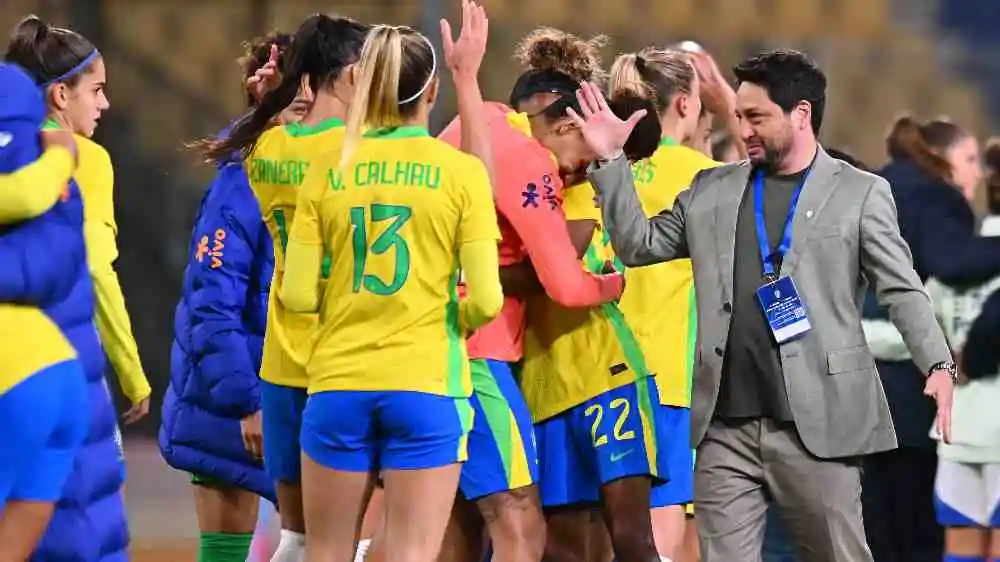
Under manager Arthur Elias, Brazil enter 2026 carrying the weight of expectation and the confidence of recent success. Their triumph at the 2025 Copa América in Ecuador, sealed in a tense penalty shootout against the Colombia women’s national team, offered more than silverware. It suggested direction.
Elias took charge in September 2023 with a clear brief: manage a generational shift without losing competitiveness. Experienced figures remain central, but a younger core is emerging. The early signs indicate the balance is taking shape.
Brazil open their 2026 calendar away from home, facing the Costa Rica women’s national team, the Venezuela women’s national team and the Mexico women’s national team over the coming week.
Those fixtures are no accident. Rather than lean on familiar surroundings, Elias has opted for environments that demand control and composure. Mexico, in particular, promises a full stadium and little sympathy.
As World Cup hosts in 2027, Brazil face a different challenge. Home friendlies rarely recreate tournament pressure. For that reason, alternative competition has become part of the planning.
The new FIFA Series offers one such platform. Brazil will host a group at the Arena Pantanal against the Canada women’s national team, the South Korea women’s national team and the Zambia women’s national team.
It is a varied mix, physically and tactically, closer to a tournament rehearsal than a routine exhibition.
The first squad list of 2026 reflects Elias’s wider thinking. Twelve players are domestically based, seven of them from Corinthians, who recently reached the Club World Cup final before falling narrowly to Arsenal.
Experience has also returned. Tamires, sidelined since the Paris Olympics after ankle ligament surgery, is back. With more than 80 caps, she brings stability to a defence that could again feature Tarciane, Lauren Leal and Thais in a back three.
Lauren’s club form with Atletico Madrid, where she has adapted to a three-centre-back system, has strengthened her case. A December Player of the Month award underlined that progress.
In attack, Palmeiras forward Bia Zaneratto remains a central figure. Her 43 international goals speak to long-term consistency, and her recent scoring run — including strikes against Portugal women’s national team, Atletico Mineiro and Gremio — has carried into the new season.
There is also attacking depth from abroad. Manchester City winger Kerolin arrives after a hat-trick against Chelsea in a 5-1 win, a reminder of the squad’s individual quality.
These matches will not define a World Cup two years away. They are not meant to. What they offer is evidence — of structure, of adaptation, of how Elias wants this side to respond when the margins narrow.
Read more:
Samsung Galaxy Galaxy S26 Ultra Review Begins: Slimmer Design and Camera Tweaks in Focus
Brazil’s status as hosts was confirmed in 2024. Since then, preparation has moved from concept to execution. The next few weeks will not provide answers to every question, but they mark the beginning of a stretch where each performance carries greater meaning.
For a team preparing to carry national expectation on home soil, the work is no longer abstract. It has started.

Follow iNews Zoombangla On Google
Open the Google follow page and tap the checkmark option to receive more updates from iNews Zoombangla in your Google news feed.