James Webb Space Telescope observations of Callisto have mapped water ice and carbon dioxide across the moon’s surface, revealing patterns linked to ancient impact basins and Jupiter’s surrounding plasma environment. JWST Callisto ancient scars is the search wording for these observations.
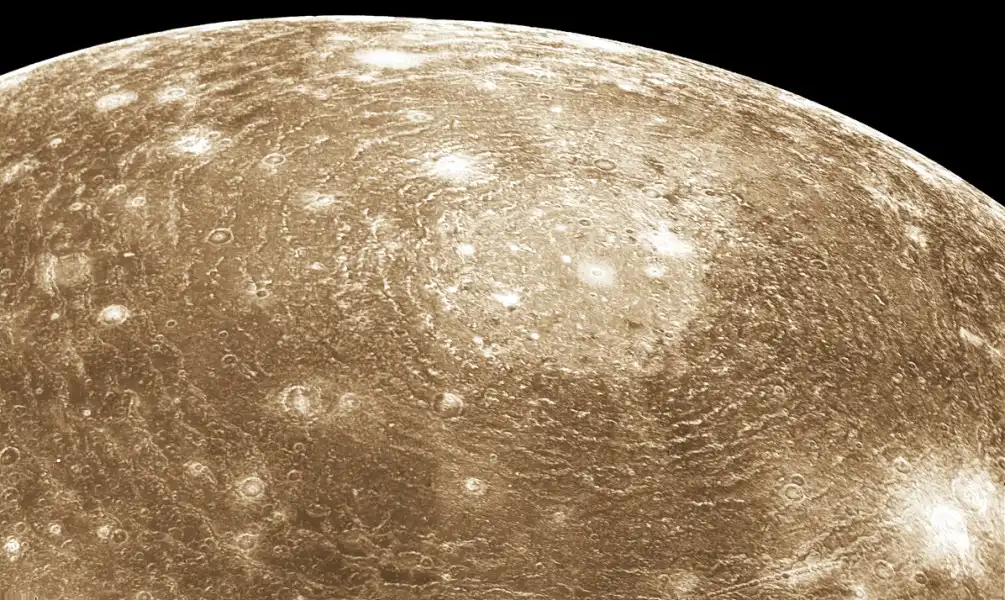
Phys.org reported that the observations used JWST’s Near-Infrared Spectrograph and examined Callisto’s leading and trailing hemispheres, including the Valhalla and Asgard impact basins.
The research found that water-ice signatures on the leading hemisphere were associated with impact features. On the trailing hemisphere, the ice showed a broad bullseye pattern that researchers linked to particles from Jupiter’s magnetosphere striking the surface.
The observations also identified solid carbon dioxide and a faint, patchy carbon-dioxide atmosphere. The arXiv paper describing the work reported that carbon dioxide was concentrated differently from the water-ice signatures, giving scientists another clue about how radiation alters the surface.
Callisto is often described as the quietest of Jupiter’s four large moons because its surface is heavily cratered and lacks the dramatic volcanic activity seen on Io. The new data show that its surface still records active chemical and physical processes.
The paper has been accepted for publication in the Planetary Science Journal and is available as a preprint. Future observations and the JUICE mission’s planned flybys will provide additional information, but the current result is based on JWST’s infrared measurements and the researchers’ interpretation of the mapped signatures.

Follow iNews Zoombangla On Google
Open the Google follow page and tap the checkmark option to receive more updates from iNews Zoombangla in your Google news feed.