Global military spending reached a record $2.9 trillion in 2025, its eleventh consecutive annual increase, and now represents 2.5 percent of world GDP. All nine nuclear-armed states are modernising or expanding their arsenals. These are the central findings of the SIPRI Yearbook 2026, released by the Stockholm International Peace Research Institute earlier this month.
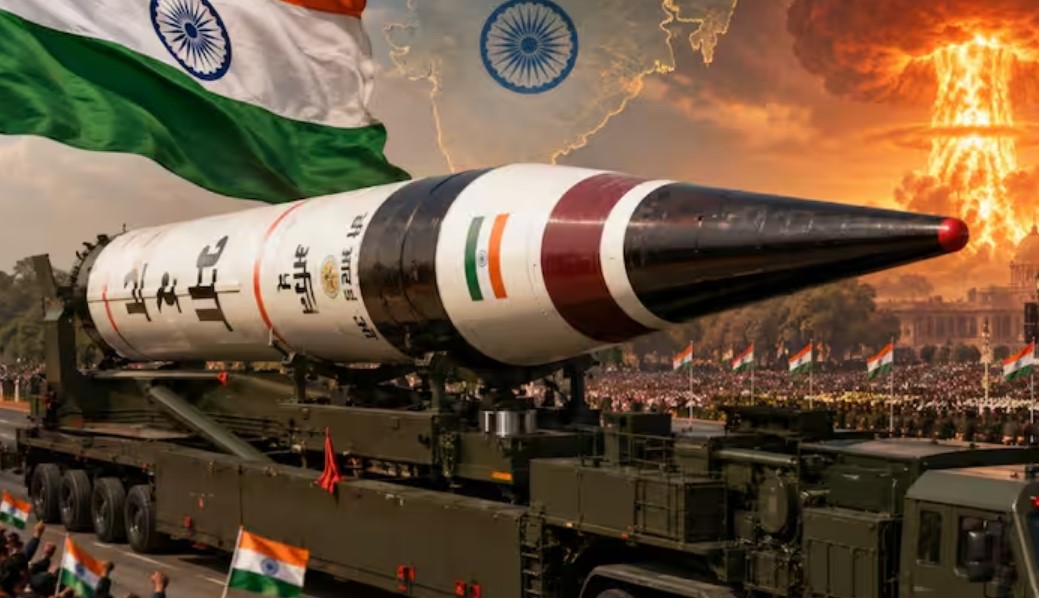
The report counted approximately 12,187 nuclear warheads across the nine states as of early 2026. Around 9,745 are in active military stockpiles. Of those, about 4,012 are deployed on missiles and aircraft, and roughly 2,100 to 2,200 are on high operational alert — meaning they can be launched within minutes. The United States and Russia together account for more than 90 percent of the world’s total nuclear inventory.
SIPRI said states are increasingly treating nuclear weapons as instruments of national power, reversing decades of effort to reduce their numbers and shrink their role in military doctrine. While the overall global stockpile has declined slowly as the US and Russia continue to dismantle older warheads, the pace of dismantlement is slowing. China, India, Pakistan and North Korea are all adding to their deployable counts rather than reducing them.
India now holds around 190 nuclear warheads and Pakistan approximately 170, according to the report. The gap between the two countries has narrowed in recent years. Pakistan continued to develop new delivery systems through 2025 and is accumulating fissile material at a rate that suggests further expansion in the coming decade. India’s strategic focus has shifted toward longer-range weapons capable of reaching targets deeper inside China, reflecting a dual-front deterrence calculation.
The volume of international arms transfers in the 2021 to 2025 period was the highest since the end of the Cold War. The ongoing conflicts in Ukraine and the Middle East have driven demand for artillery, air defence systems and precision strike munitions. European governments, many of which had allowed their stockpiles to decline significantly after 2000, have been purchasing aggressively to rebuild reserves depleted by transfers to Ukraine.
SIPRI’s authors noted the convergence of several risk factors — the Iran-US conflict, the Russia-Ukraine war, renewed India-Pakistan tension, and China’s military expansion — as creating a more dangerous nuclear environment than at any point since the early 1980s. The report called on states to resume arms control dialogue and to reinstate transparency measures that several countries have suspended in recent years.
The SIPRI press release accompanying the yearbook said the organisation was particularly concerned about the breakdown of multilateral arms control mechanisms that had provided constraints on nuclear competition since the 1990s. The New START treaty between the US and Russia lapsed in 2026 without a replacement. No multilateral framework currently exists to limit the arsenals of China, India, Pakistan, North Korea or Israel.

Follow iNews Zoombangla On Google
Open the Google follow page and tap the checkmark option to receive more updates from iNews Zoombangla in your Google news feed.