Japan’s government picked SoftBank-backed Noetra to build a national AI model for robots, committing up to 1 trillion yen ($2.3 billion) in public funding over five years. The consortium structure includes 44 Japanese corporations—Honda, Sony, SoftBank—pooling resources to ensure Japan doesn’t fall behind the U.S. and China in the robotics race.
Noetra won a competitive tender alongside AIST, a national research institute. The project runs from fiscal 2026 to 2030, with an ambitious roadmap: build a reasoning model this year, evolve into an omni-modal model by 2028, and achieve real-world native Physical AI by 2030. That timeline is aggressive but not impossible if execution stays on track and political backing holds.
Multimodal Foundation Model for Real-World Robots
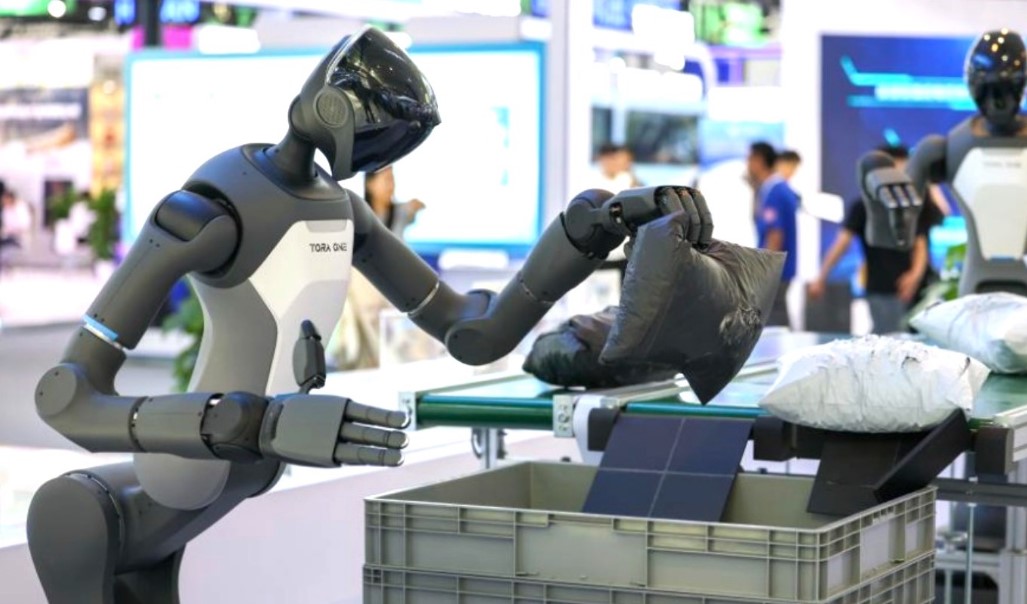
The core product is a multimodal foundation model that combines language, images, video, and sensor data. Robots need to interpret their physical environment—surfaces, obstacles, human behavior—and act on that interpretation safely. Text-only AI can’t do that. A model trained on multimodal data can reason about the physical world in ways large language models cannot.
Noetra’s approach sidesteps the trap of building yet another large language model in a crowded market. Instead, it’s building infrastructure specifically for robotics. That focus matters. Nvidia’s involvement in GPU supply and the planned AI data center with 27,500 Rubin GPUs shows Japan is betting on scale. Construction begins April 2027, operations start June 2028.
Japan’s 10 Million Robot Goal and Labor Crisis Context
Japan’s endgame is deploying 10 million AI-enabled robots by 2040. That’s not fantasy—it’s a response to demographic collapse. Japan’s working-age population is shrinking fast. Robots aren’t a luxury, they’re a necessity. Agriculture, construction, and elder care face catastrophic labor shortages. Noetra is Japan’s bet that it can build the foundation to address that shortage domestically instead of outsourcing to imported models or foreign AI companies.
If Noetra succeeds, Japan regains relevance in the AI race. If it stalls, Japan’s future looks like permanent dependency on U.S. and Chinese AI platforms. The stakes for Japan are existential.