A new small-form-factor gaming PC build shows how much hardware can fit into a case measuring only 4.6 liters. Geeky Gadgets reported on the system after ETA Prime demonstrated it with an AMD Radeon RX 9060 XT graphics card and a Ryzen 7 7700X processor. The story is less about a retail computer than about the design choices needed to make a powerful gaming system fit inside a very small enclosure.
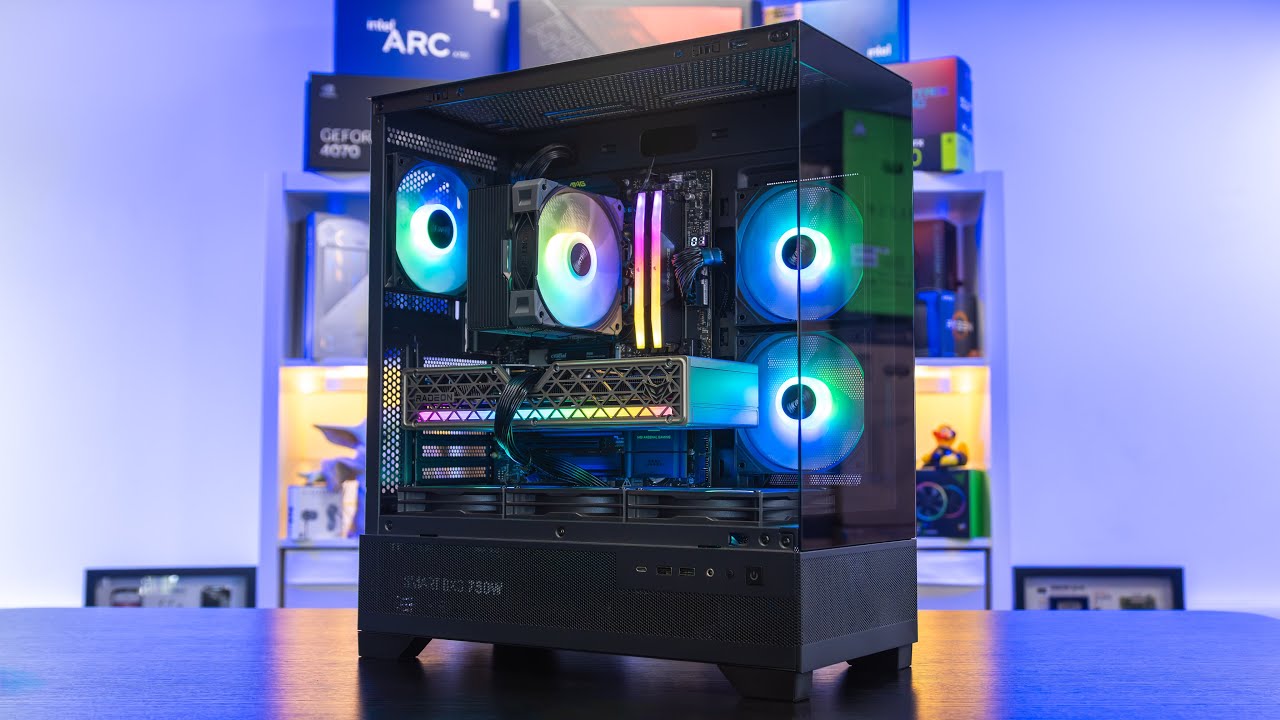
The build uses the LZOD A24 V5 Gen 1 aluminum case. Its 4.6-liter volume is the central figure in the report, and the case is small enough to make every component choice matter. A compact enclosure can save desk space and make a system easier to carry, but it leaves less room for airflow, cable routing and future upgrades.
The graphics card is the main challenge. Geeky Gadgets identifies the card as a 16GB Radeon RX 9060 XT and describes a 140W power figure for the card used in the build. AMD’s published reference material lists 160W total board power for the 16GB model and 150W for the 8GB model. Partner cards can use different designs, so the 140W figure should be read as a build-specific description rather than a universal RX 9060 XT rating.
AMD’s product record lists 32 compute units, 2,048 stream processors and a boost frequency of up to 3,130MHz for the RX 9060 XT family. The official specifications also include GDDR6 memory, a 128-bit interface, DisplayPort 2.1a and HDMI 2.1b. Those numbers describe the graphics processor. They do not predict the frame rate of every small PC, because cooling, drivers, game settings and the chosen board can change the result.
The rest of the parts are selected around the case. The report lists an ROG B850I Mini-ITX motherboard, 32GB of Kingston Fury Renegade DDR5 memory and a 1TB Kingston M.2 solid-state drive. The Ryzen 7 7700X provides eight cores and 16 threads, with a maximum boost clock of 5.4GHz in AMD’s product specifications. The combination gives the system a desktop-class platform while keeping the motherboard footprint small.
Cooling is another constraint. The build uses a Thermalright APX120 X67 low-profile cooler, which the report lists at 67mm tall. A fully modular Aiva 1U or Flex ATX power supply is used to reduce cable bulk. In a case this size, the power supply, cooler and cables must work together; a physically compatible part can still be a poor choice if it blocks airflow or makes service difficult.
Geeky Gadgets reported benchmarks from the ETA Prime demonstration, including an overall 3DMark Time Spy score of 14,428. The report also lists averages such as 86 frames per second in Red Dead Redemption 2 at 1440p Ultra and 66 frames per second in Forza Horizon 6 at 4K with FSR Balanced. These are results from that particular configuration and test process, not a guarantee for every RX 9060 XT system.
The compact design also brings limits. Higher power can raise heat, fan noise and battery-free desktop power use, while tighter parts can make upgrades harder. A buyer would need to check the exact graphics-card dimensions, cooler clearance, power-supply format and motherboard support before copying the build.
The 4.6-liter RX 9060 XT PC is a useful example of where small-form-factor gaming stands today. Modern components can deliver strong desktop performance in a very small case, but the result depends on careful part matching and measured thermal behavior. The demonstration supports that design possibility; it does not remove the trade-offs that come with limited space.

Follow iNews Zoombangla On Google
Open the Google follow page and tap the checkmark option to receive more updates from iNews Zoombangla in your Google news feed.