Saudi Arabia, Pakistan, and Turkey signed a joint defence agreement in Mecca on Friday, tying the three largest Muslim-majority countries into a single mutual security framework for the first time.
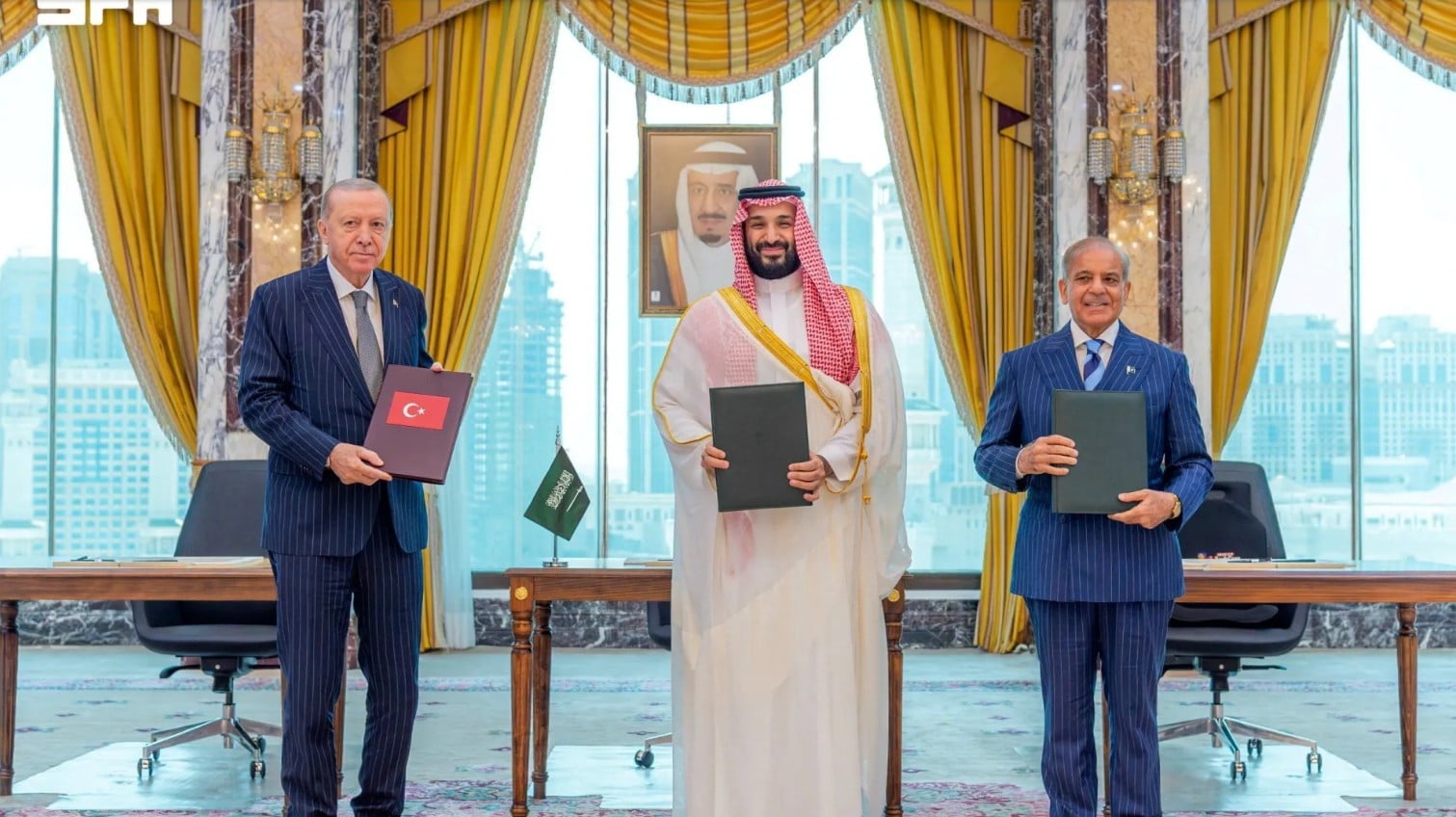
The deal, described by officials as the Mecca Joint Defence Agreement, was signed by Turkish President Recep Tayyip Erdogan, Saudi Crown Prince and Prime Minister Mohammed bin Salman, and Pakistani Prime Minister Shehbaz Sharif, according to reporting from Al Jazeera and CNN.
At its core, the pact treats an attack on any one signatory as an attack on all three, language that mirrors NATO’s Article 5 mutual defense clause. Officials framed the agreement as a way to strengthen collective deterrence against aggression and deepen defense cooperation across the three militaries.
The signing caps roughly a year of negotiations, according to the Washington Post, and comes at a moment of heightened regional tension following Israeli and US strikes on Iran earlier this year. Choosing Mecca, Islam’s holiest site, as the signing location added symbolic weight to an agreement that formalizes ties Saudi Arabia and Pakistan have held informally for decades.
Pakistan’s status as the only nuclear-armed country among the three has drawn particular attention to the pact, with some analysts describing it as a pointed signal toward Israel and other regional rivals, even though none of the three governments has framed it that way publicly.
Turkey’s inclusion marks an expansion beyond the bilateral Saudi-Pakistan military relationship that has underpinned the region’s security architecture for years. Reports from Middle East Eye and Gulf News note that Ankara had been seeking a formal role in exactly this kind of arrangement for some time, positioning itself alongside two of the Gulf and South Asia’s most significant military powers.
What the agreement means in practice, including any joint military exercises, basing arrangements, or arms-sharing provisions, has not been detailed publicly, and officials from all three countries have so far kept specifics limited to the mutual defense language itself.

Follow iNews Zoombangla On Google
Open the Google follow page and tap the checkmark option to receive more updates from iNews Zoombangla in your Google news feed.