Astronomer Rohan Naidu is part of the team behind a report on MoM-BH*-1, a distant black hole star observed during the early history of the universe. Space.com reported that the object existed less than 660 million years after the Big Bang and was identified through research connected to the James Webb Space Telescope’s study of little red dots.
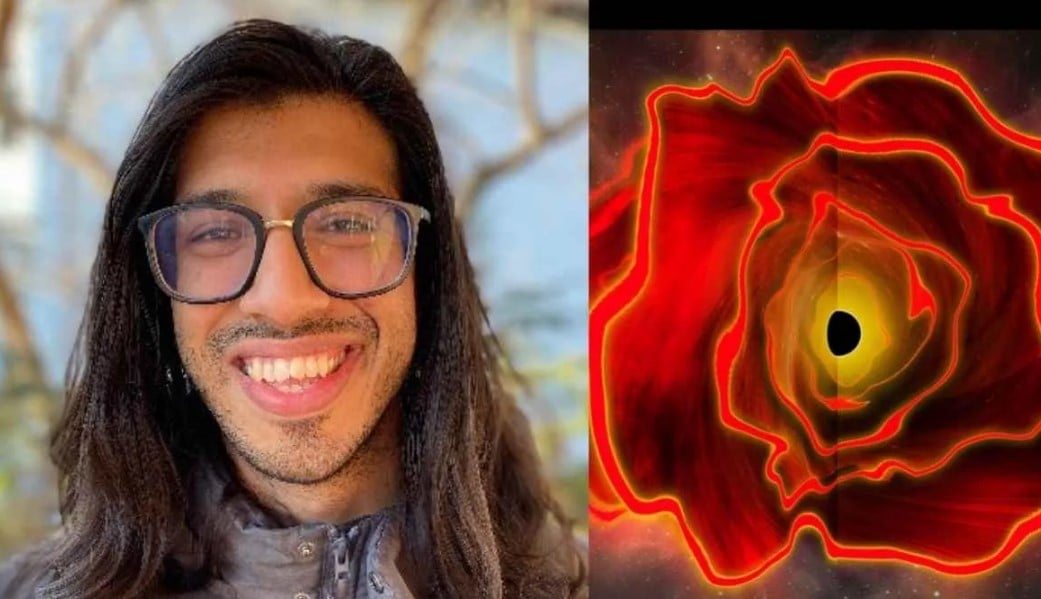
The researchers describe MoM-BH*-1 as a black hole surrounded by a dense gas cloud. The system is presented as a possible example of a black hole star, in which a growing black hole is embedded in material that can make the object appear different from a normal young galaxy. The interpretation comes from the observed light and the model used to explain it.
Naidu, a University of Hawaii astronomer, helped lead the team and co-leads the broader group working on the little-red-dot observations. Space.com reported that the nearby young galaxy may merge with the system in roughly 100 million years. That estimate is a research projection, not a direct observation of a completed merger.
The Open Journal of Astrophysics paper examined a sample of 98 little red dots. It reported population-level evidence involving ultraviolet, Balmer and longer-wavelength signals, and discussed the black-hole-star model as an interpretation of the data. The paper’s sample-level results provide context for the single-object report.
The discovery does not settle every question about little red dots. The sources present the black hole-star model as a way to explain the observations, while the journal paper tests the broader population. Additional observations and analysis are needed to determine how widely the model applies.