India’s next ethanol milestone will depend on more than producing and blending fuel. A white paper from the All India Distillers’ Association and IIT Delhi says the country also needs vehicles, fuel stations, financing and consumer support that can work together. The India flex-fuel vehicle roadmap gives the technology side of the transition a clearer place in the discussion after the nationwide rollout of E20 fuel.
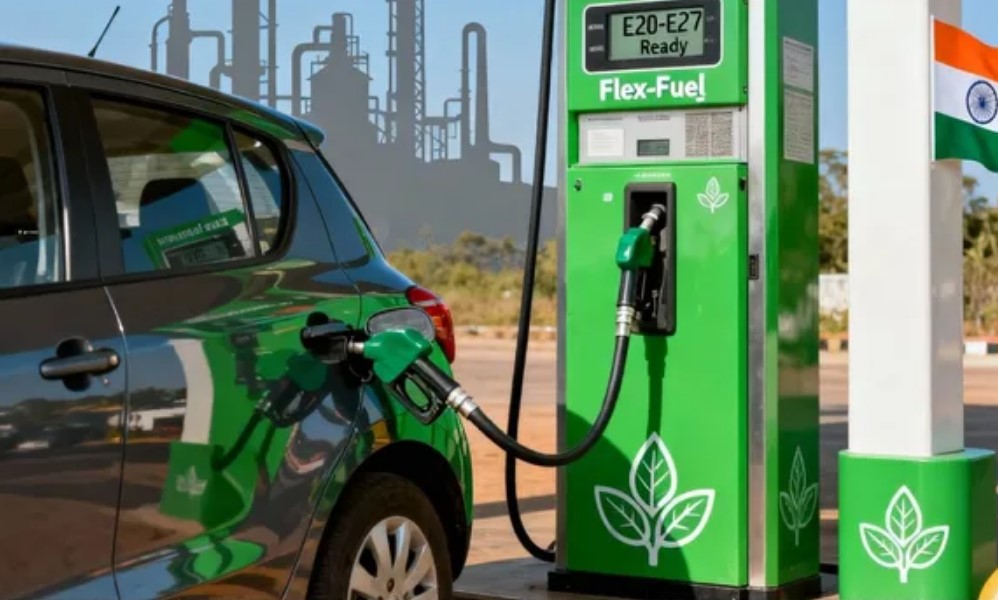
Autocar Professional reported that the paper, Flex-Fuel Vehicles: Enabling Energy Security and Sustainable Mobility in India, was released at the AIDA Green Energy Seminar 2026. A separate report from ET EnergyWorld said the study calls for wider use of flex-fuel vehicles, which can run on petrol, high-ethanol blends such as E85 or a mixture of both. The vehicle must be designed and calibrated for the fuels it is expected to use.
That distinction matters because a higher blend is not simply a software setting. Fuel-system materials, engine calibration, cold-start behavior, emissions control and long-term durability all have to be considered. Automakers also need testing and certification processes that show how a vehicle behaves across the intended fuel range. The white paper does not announce a new production model or a nationwide sales date; it sets out the conditions needed for adoption.
IIT Delhi’s ten-point framework covers vehicle technology, fuel pricing, refuelling infrastructure, sustainable feedstock, consumer acceptance, vehicle finance and market creation. Those items are connected: a driver is unlikely to choose a flex-fuel vehicle if compatible fuel is hard to find or costs more without a clear running-cost benefit. A fuel retailer will be cautious about adding equipment if too few vehicles can use it. The roadmap therefore treats the car, the fuel and the supporting network as one system.
Fuel pricing is one of the practical questions. Ethanol content can change the energy available in a litre, so a cheaper pump price does not automatically tell a driver what a full tank will cost to use. The calculation also depends on the engine, the blend and the distance travelled. Transparent price and efficiency information would help buyers compare vehicles on real running costs instead of relying on the headline price of a fuel blend.
Infrastructure is another constraint because flex-fuel vehicles need dependable access to approved blends. That means storage, dispensing equipment, quality checks and a supply chain that can serve different regions. The study’s emphasis on distribution networks recognises that vehicle technology cannot scale ahead of the fuel system indefinitely. Early deployment may need to focus on routes and markets where supply can be monitored closely.
The companion CRID India paper adds a resource question. Its analysis estimates that land attributable to ethanol production stood at about 3.46 million hectares in 2023–24, or roughly 1.58% of India’s gross cropped area. That figure is a study estimate, not a guarantee that future expansion has no effect on food, land or water. Feedstock planning, crop yields, co-products and regional water conditions will influence the outcome.
For automakers, a flex-fuel programme could offer another path alongside electric vehicles, hybrids, CNG and conventional petrol. It would not replace those technologies, and it would not remove the need for cleaner engines and strong emissions control. The business case will depend on development cost, fuel availability, vehicle price, service capability and whether customers see a useful benefit.
The roadmap’s main message is straightforward: E20 is a fuel milestone, while flex-fuel mobility is an engineering and market-design challenge. The next evidence will come from certified vehicles, compatible retail infrastructure, transparent operating data and sustained customer demand. Until those pieces appear at scale, the AIDA and IIT Delhi paper should be read as a framework for action rather than proof that a nationwide flex-fuel market already exists.

Follow iNews Zoombangla On Google
Open the Google follow page and tap the checkmark option to receive more updates from iNews Zoombangla in your Google news feed.