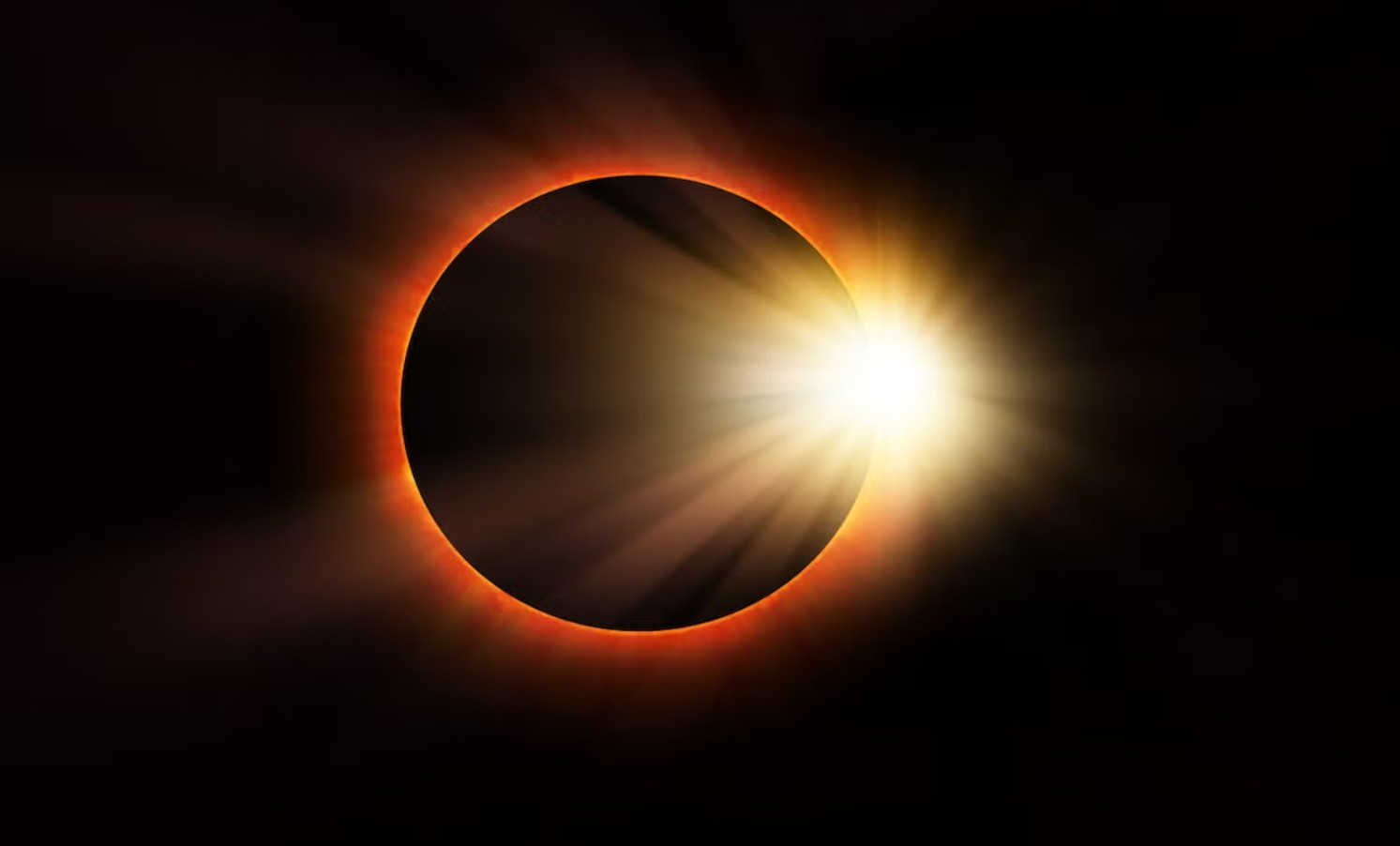
On February 17, the Moon slid across the Sun’s path and produced an annular solar eclipse, the kind that leaves a bright ring instead of full darkness. Unless you were far into the southern hemisphere, it was easy to miss.
Yet for a certain kind of believer, visibility has never been the point. In astrology, an ancient tradition that lacks scientific grounding, eclipses are treated as potent political events whether anyone looks up or not. That old habit is resurfacing again, this time with modern names attached.
Astrologers read eclipses through horoscopes, charts that place the Sun, Moon and planets across the 12 zodiac signs. During this eclipse, the Sun and Moon sat at the edges of Aquarius, a position astrologers associate with endings and shakeups. Combined with other factors cited by astrologers, including that Donald Trump was born during a lunar eclipse in 1946, some have argued the February 17 eclipse signals the start of a severe crisis for the US president, even his death.
Those forecasts are hardly new in shape, even if the target changes. For thousands of years, eclipses have been treated as political messages written in the sky, read as warnings about kingdoms and the people who rule them.
In ancient Mesopotamia around 4,000 years ago, observers in what is now Iraq kept lists of signs they believed foretold specific outcomes. Among them was one line that proved stubbornly durable: if there is an eclipse, the king will die. With that kind of threat hanging over the court, prediction became a serious business. Systematic observation and calculation helped refine eclipse forecasts, and it also fed a ritual workaround: the “substitute king,” a temporary stand-in meant to absorb whatever fate the eclipse carried.
Versions of the same fear traveled. Egyptian papyri show evidence of the belief, and Greek and Roman history is crowded with eclipse tales tied to prominent deaths. Cassius Dio described a solar eclipse around the death of Augustus in AD14 when “most of the sky seemed to be on fire.” In the gospels of Matthew, Mark and Luke, the death of Jesus is marked by a darkened Sun.
Later chroniclers kept making the same connections. Medieval Arabic writers often noted eclipses alongside rulers’ deaths, and in England a solar eclipse in 1133 became so linked with King Henry I’s death in 1135 that it earned the name “King Henry’s Eclipse.”
Rulers, for their part, tried to control the story. They hired astrologers for birth charts that could be turned into flattering propaganda, but they reacted sharply when predictions turned grim. Astrologers were expelled from ancient Rome repeatedly, and Suetonius recounted how an astrologer named Ascletarion was executed after predicting Emperor Domitian’s imminent downfall.
Centuries later, an astrologer in Oxford was executed for predicting the death of Edward IV, and in 1581 Elizabeth I made it a felony to use horoscopes to predict her death or name her successor. French royal pronouncements in 1560, 1579 and 1628 similarly banned predictions about princes, states and public affairs, while in Italy astrologers ran into serious trouble for predicting popes’ deaths.
It was not only royal nerves. Authorities feared what predictions could do to public order. In the wars of the three kingdoms between 1639 and 1653, radical forecasts about the English monarchy helped feed revolutionary feeling. Nicholas Culpeper went as far as predicting the downfall of all European monarchies on the basis of a 1652 solar eclipse.
Astrology later slipped out of universities and courts, but it kept finding its way back into politics. In 1790s London, an astrologer named William Gilbert predicted the death of Sweden’s King Gustav III, a prophecy said to have been fulfilled months later. After the attempted assassination of Ronald Reagan in 1981, astrologer Joan Quigley claimed she could have foreseen it, and she later said she advised the Reagans for years, including on the timing of political announcements.
That history helps explain why eclipse predictions still carry a charge today. Whether any specific forecast comes true is almost beside the point. What has made eclipses politically dangerous, again and again, is the speculation people attach to them, and the fear that spreads faster than the shadow itself.

Follow iNews Zoombangla On Google
Open the Google follow page and tap the checkmark option to receive more updates from iNews Zoombangla in your Google news feed.