The next wave of industrial transformation is not about replacing workers with machines. It is about giving those workers a machine that thinks with them.
On the factory floor of a Volkswagen plant in Hanover, a robotic arm pauses mid-motion and waits. The human technician beside it has spotted a misaligned component. The machine does not override the decision or proceed autonomously. It learns, adjusts, and defers. This small, unremarkable moment is, in many ways, the defining image of where global industry is headed.
For two decades, the conversation around industrial technology has been dominated by a single, anxious question: which jobs will the robots take? Industry 4.0 gave that question urgency. It brought smart factories, internet-connected supply chains, and a dramatic expansion of automation that remade manufacturing as we knew it. But the gains were lopsided. Efficiency soared while worker agency shrank. Now, something is changing.
From automation to augmentation
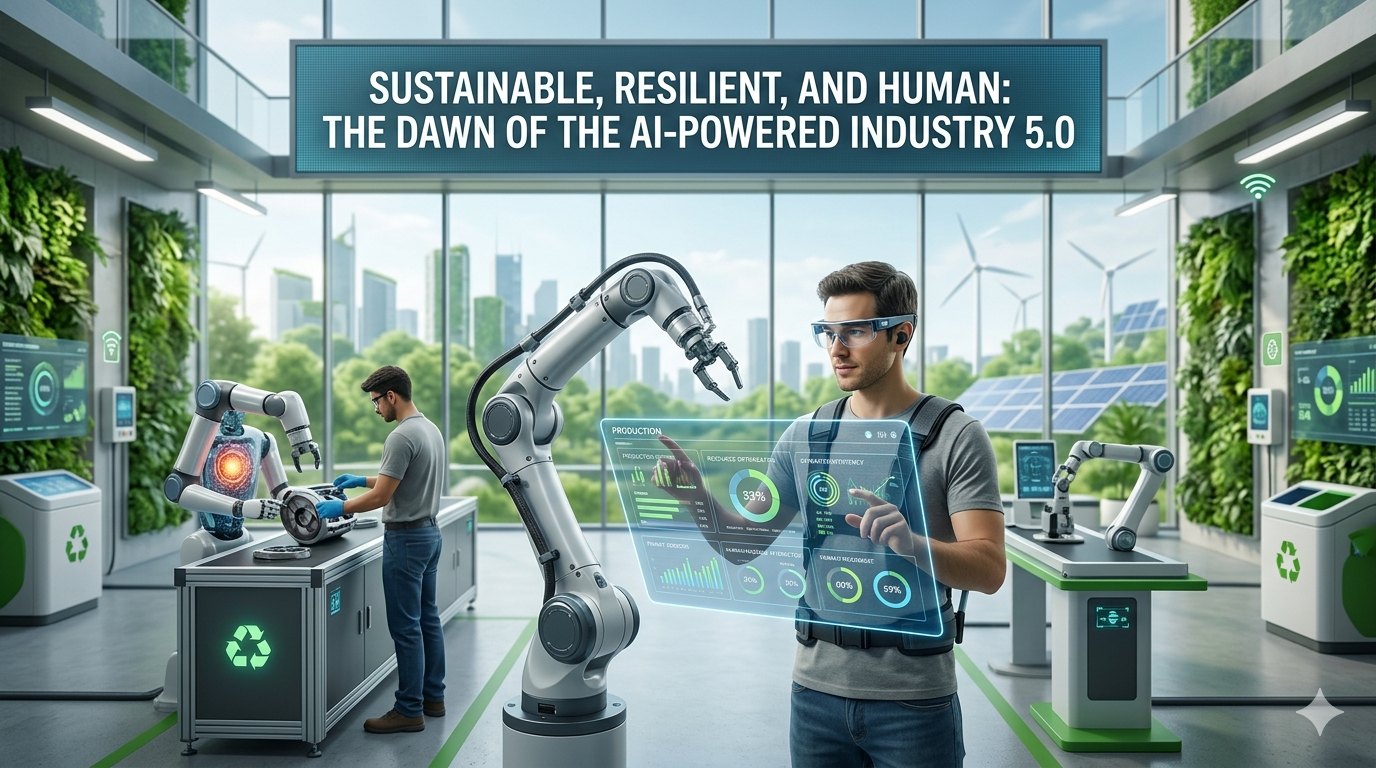
Industry 5.0 is not a rejection of what came before. It is a correction. Where the fourth industrial revolution asked how much human labor could be removed from a process, the fifth asks how that process can be made more deeply human. The European Commission, which formally introduced the framework in 2021, placed worker wellbeing at the center of the production process, treating technology not as an end but as a means toward a broader societal goal.
“Now is the time to make workplaces more inclusive, build more resilient supply chains and adopt more sustainable ways of production.”
Mariya Gabriel, European Commissioner for Innovation, Research, Culture, Education and Youth
Source: European Commission, Industry 5.0 official launch statement, January 2021. research-and-innovation.ec.europa.eu
The practical difference is substantial. Collaborative robots, known as cobots, are now designed to operate alongside workers rather than in sealed-off cells. They handle the repetitive, physically dangerous, or ergonomically punishing elements of a task while the human retains judgment, creativity, and oversight. AI systems analyze performance data not to flag workers for disciplinary review but to adapt workflows to individual capacity, reduce fatigue-related errors, and personalize production at a granular level.
What the numbers say
A field experiment conducted by MIT Sloan School of Management and Johns Hopkins University, involving 2,310 participants, found that humans working in human-AI teams experienced 73 percent higher productivity per worker and created higher-quality output in complex creative tasks compared to human-only teams. The same study noted that human-only teams retained an edge in multimodal work, a reminder that the collaboration is genuinely bidirectional and that AI is not a wholesale replacement for human judgment in every domain.
Source: MIT Sloan School of Management and Johns Hopkins University, cited in EY Megatrends Report, November 2025.
A revolution built to last
Beyond the factory floor, Industry 5.0 addresses something that its predecessor largely ignored: the relationship between industrial growth and planetary survival. The fourth revolution delivered remarkable productivity gains but also expanded energy consumption and resource extraction at scale. The fifth revolution is attempting something more difficult, decoupling output from environmental cost.
AI is central to that effort. Machine learning systems are being used to optimize energy consumption in real time across entire production facilities, identifying inefficiencies invisible to human managers and adjusting heating, cooling, and machinery cycles accordingly. Circular economy models, once considered impractical at industrial scale, are becoming viable because AI can now manage the logistics complexity they require.
The resilience argument is equally compelling. The supply chain crises of the early 2020s exposed just how fragile hyper-optimized, globally concentrated production had become. Industry 5.0 promotes distributed manufacturing and adaptive supply networks, where AI can reroute production and sourcing in response to disruption. Market research projects the global Industry 5.0 market will grow from $65.8 billion in 2024 to $255.7 billion by 2029, reflecting a compound annual growth rate of 31.2 percent.
The human dividend
None of this unfolds automatically. The transition to Industry 5.0 demands investment not just in technology but in people. Retraining programs, inclusive design standards, and labor policies that give workers a voice in how AI systems are deployed are not peripheral concerns. They are the architecture on which the revolution depends. Countries and companies that treat them as afterthoughts will find themselves with sophisticated machines and a workforce that neither trusts nor knows how to use them.
The stakes are high, but so is the potential. If Industry 5.0 delivers on its ambitions, it will not be remembered as the era when artificial intelligence took over the global economy. It will be remembered as the moment when technology finally grew sophisticated enough to serve the complexity of human work rather than reduce it. That is a different kind of progress and, arguably, the only kind worth having.

Follow iNews Zoombangla On Google
Open the Google follow page and tap the checkmark option to receive more updates from iNews Zoombangla in your Google news feed.